Tiếng Việt
 日本語
日本語 한국어
한국어
In modern manufacturing, businesses can no longer operate efficiently by relying solely on a standalone design software or a single machining tool. The prevailing trend today is to build an integrated CAD/CAM/CAE ecosystem for the manufacturing industry, connecting the entire product lifecycle—from design and simulation to machining programming and production management. Let’s explore this topic with SDE Tech in the article below.
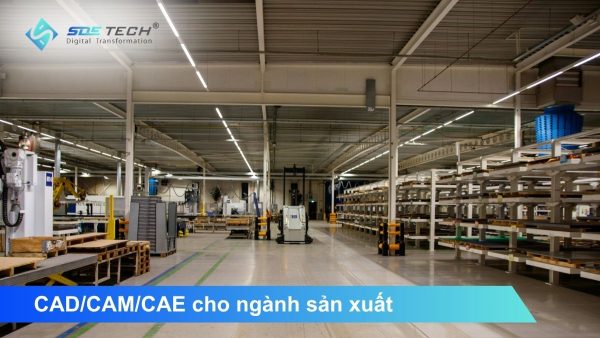
1. The Importance of CAD/CAM/CAE in Manufacturing
In modern manufacturing, businesses not only need to produce products that meet requirements, but also must do so faster, more accurately, and at a more reasonable cost. Therefore, CAD/CAM/CAE has increasingly become an indispensable trio of technologies in the product development process.
CAD enables businesses to build clear and precise digital design models. CAM transforms those designs into actual machining programs for CNC machines. CAE allows products to be validated before production by simulating working conditions, helping identify risks early and reducing reliance on physical testing. When these three elements are connected, companies can significantly shorten the cycle from concept to finished product.
The greatest value of CAD/CAM/CAE in manufacturing lies not only in process digitalization, but also in the ability to create a seamless data flow across design, engineering, simulation, and production. Instead of each department working with separate datasets, businesses can operate on a unified platform, minimizing data discrepancies and improving collaboration.
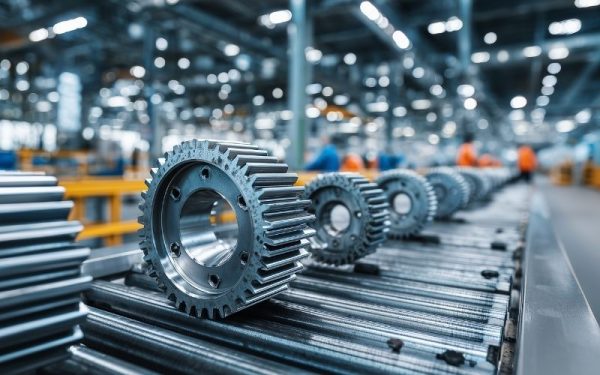
2. CAD: The Foundation for Product Design and Manufacturing Processes
Within the CAD domain, two notable names are NX and CrownCAD. NX by Siemens is an integrated CAD/CAM solution positioned for both design and manufacturing on a unified digital platform. Meanwhile, CrownCAD is a cloud-native CAD platform that runs in the browser, supporting real-time collaboration and intelligent version control—well-suited for businesses seeking more flexible and distributed workflows.
For manufacturing companies, CAD is not just about modeling. It is the starting point of the entire engineering value chain, where geometric data, dimensions, assemblies, and technical drawings are created and used throughout CAM, CAE, and PLM processes. When CAD data is well-structured, downstream steps can significantly reduce time spent on data conversion and error correction.
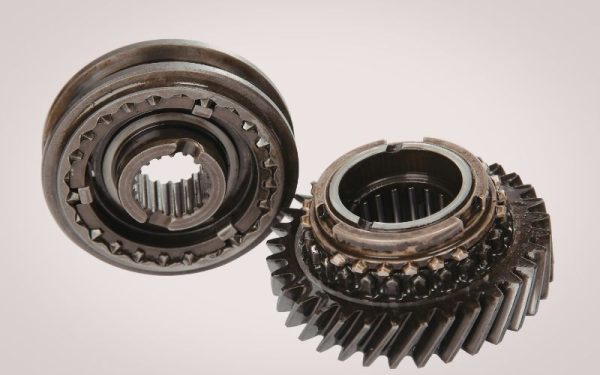
3. CAM: Optimizing CNC Machining, Reducing Cycle Time and Programming Errors
In the CAM domain, solutions such as Mastercam, VoluMill, MANUSsim, MANUSpost Developer, and MANUSsim Optimize stand out.
Mastercam is recognized as one of the leading CAD/CAM software solutions for CNC programming, while VoluMill is a rough-milling solution focused on fast and stable material removal. MANUSpost Developer is a cloud-based platform for developing post processors, and MANUSsim is a realistic CNC simulation software that helps validate NC programs before actual machine execution. MANUSsim Optimize focuses on optimizing NC programs by reducing air cuts, minimizing unnecessary movements, and shortening cycle time.
The strength of this CAM solution group lies not only in toolpath generation but also in enabling businesses to control the entire post-processing and simulation stages before production.
For example, VoluMill can automatically control the material removal rate to prevent tool overload, while MANUSpost Developer allows users to work with extensive post libraries and customize them according to specific CNC machines. MANUSsim Optimize goes further by directly analyzing NC programs to optimize non-cutting movements, thereby improving real-world efficiency without requiring changes to the original CAM setup.

4. CAE: Simulation for Product Validation Before Production
In the CAE domain, three highly suitable solutions are Particleworks, Granuleworks, and Simcenter STAR-CCM+. Particleworks uses the MPS (Moving Particle Simulation) method to simulate fluids such as water and oil with large free-surface behavior, making it ideal for complex flow problems in manufacturing. Granuleworks is a particle simulation software based on DEM (Discrete Element Method), specialized for phenomena such as mixing, conveying, and filling. Simcenter STAR-CCM+ is a CFD and multiphysics software used to simulate products under real operating conditions.
For manufacturing companies, CAE serves as a critical validation layer before investing in molds, machinery, or production lines. Particleworks is particularly effective for lubrication, churning, aeration, and heat transfer problems; Granuleworks is well-suited for granular flows, powders, and bulk materials; while STAR-CCM+ excels in CFD, heat transfer, fluid-structure interaction, and multiphysics simulations. As a result, businesses can identify risks earlier, reduce reliance on physical testing, and make more accurate design decisions.
5. How Should Manufacturing Companies Build a Software Ecosystem?
An effective CAD/CAM/CAE system for manufacturing does not necessarily require using every software solution at once, but it must ensure seamless data flow across all layers. Businesses can choose NX or CrownCAD for CAD; Mastercam, VoluMill, MANUSsim, MANUSpost Developer, and MANUSsim Optimize for CAM; and Particleworks, Granuleworks, and STAR-CCM+ for CAE, depending on their specific use cases. The key is that these tools must align with the company’s processes, rather than making them more fragmented.
With this model, CAD establishes the design foundation, CAM ensures stable machining, and CAE enables early validation. This is how modern manufacturing companies optimize the product lifecycle, reduce waste, and enhance their competitive advantage.
6. Frequently Asked Questions
6.1 Why should businesses use an integrated CAD/CAM/CAE system in manufacturing?
Because an integrated approach helps reduce rework, maintain connected data, accelerate the design-to-machining process, and minimize errors when transferring information between departments.
6.2 Is CAE mandatory before production?
It is not mandatory, but it is highly recommended to use CAE in the early stages, as it helps identify risks sooner, reduce prototyping costs, and improve product reliability before actual manufacturing.
6.3 Do small businesses need CAD/CAM/CAE?
Yes. Even small businesses can benefit from reduced errors, shorter development time, and less reliance on physical testing when CAD/CAM/CAE is applied effectively.
From a practical manufacturing perspective, CAD/CAM/CAE is no longer just a theoretical concept but a concrete implementation strategy that enables businesses to accelerate innovation, reduce errors, and optimize costs. With this orientation, SDE Tech can accompany businesses in selecting and deploying solutions tailored to real-world design, simulation, and machining challenges. Contact us now:
- Website: sde.vn
- Email: sales@sde.vn
- Hotline/Zalo: 085 256 2615 – 0909 107 719