Tiếng Việt
 日本語
日本語 한국어
한국어
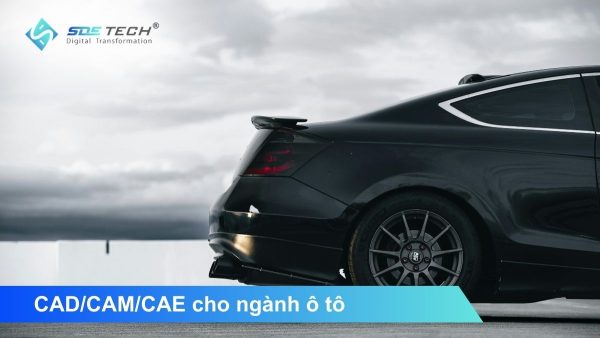
In the context of the global and Vietnamese automotive industries rapidly transitioning toward electric vehicles (EVs) and autonomous driving, the pressure to shorten time-to-market has never been greater. By 2026, relying on standalone tools is no longer sufficient; companies need an integrated CAD/CAM/CAE ecosystem for the automotive industry to effectively control and compete within the global supply chain.
1. The Importance of CAD/CAM/CAE Systems in the Automotive Industry
The automotive industry is a complex integration of tens of thousands of components—from mechanical parts to electronics and advanced materials. Even the smallest deviation can lead to massive product recalls. Therefore, CAD/CAM/CAE systems are critically important in automotive engineering.
1.1. What is CAD/CAM/CAE in Automotive? A Seamless Integration
This system forms a “Digital Loop”, ensuring continuity across the entire product lifecycle:
- CAD (Computer-Aided Design): Concept creation and detailed design
- CAE (Computer-Aided Engineering): Simulation and virtual testing for strength, durability, and aerodynamics
- CAM (Computer-Aided Manufacturing): CNC programming to manufacture the final product. The seamless integration of these three ensures that: what you design can be simulated, and what you simulate can be manufactured accurately.
1.2. Stringent Requirements for Accuracy and Tolerances
Components such as engine blocks, suspension systems, and drivetrains require extremely high precision (micron-level tolerances). Specialized software systems for the automotive industry must be capable of accurately handling complex surfaces and managing massive assembly data without introducing errors during format conversion.
1.3. Challenges for Vendors: Reducing Lead Time and Optimizing Costs
Major OEMs consistently impose extremely tight delivery deadlines. If vendors continue to rely on manual processes or incompatible software, repeated design revisions can quickly erode profit margins. Optimizing the technology workflow is the only way to reduce scrap and shorten customer response time.
2. CAD Solutions: From High-End Standards to Flexible Cloud Platforms
By 2026, automotive design is no longer just about solid modeling—it’s about advanced surface control and real-time collaboration.
2.1. Siemens NX – The Gold Standard for Class-A Surfacing and BIW Design
Siemens NX has long been a “heavyweight tool” used by major OEMs such as Mercedes-Benz, Nissan, and VinFast.
- Class-A Surfacing: Delivers perfectly smooth exterior surfaces with flawless light reflection—an essential requirement for automotive body design.
- BIW (Body-in-White): Provides specialized tools for vehicle body structure design, including weld optimization and structural stiffness analysis.
2.2. CrownCAD – Cloud CAD Solution for Supporting Manufacturers
Not every company needs a full-scale installation like Siemens NX.
CrownCAD emerges as a flexible cloud-based CAD solution:
- Benefits: No installation required, no need for high-performance hardware
- Use Cases: Ideal for quotation teams or field engineers who need to quickly view and edit drawings directly on a web browser—helping significantly reduce software licensing costs
3. CAE Solutions: High-Speed Virtual Testing with Particleworks
Before tooling or mass production, every automotive component must pass through a “virtual testing environment.”
3.1. The Role of Fluid Simulation in Engine Performance
The stability of an automotive engine depends heavily on effective lubrication and cooling. Traditional testing methods are extremely costly, often requiring significant investment for each prototype iteration. CAE enables accurate prediction of thermal hotspots and areas with insufficient lubrication, helping optimize performance before physical testing.
3.2. Particleworks (Meshless CFD): A Breakthrough Without Meshing
Unlike traditional CFD tools such as ANSYS or STAR-CCM+, which require time-consuming mesh generation, Particleworks uses the MPS (Moving Particle Simulation) method.
- Advantage: Eliminates complex meshing—simulation setup can be completed in minutes
- Speed: Excels in handling free-surface flow problems with high speed and visual clarity
3.3. Real-World Applications
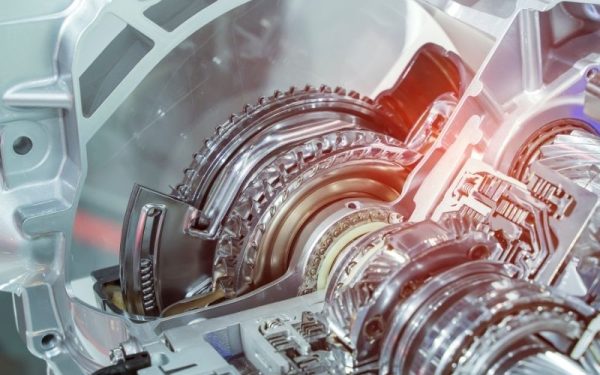
- Gearbox Lubrication: Accurately visualize oil distribution and splashing behavior inside gearboxes at high rotational speeds
- Water Wading: Simulate water interaction with the engine bay when vehicles pass through flooded conditions—critical for SUVs and EVs in Southeast Asian markets
4. CAM Solutions: Maximizing Machining Shop Productivity
Automotive manufacturing often involves high-volume production or large-scale mold machining, where CNC machine efficiency directly impacts product cost.
4.1. Mastercam – The World’s Most Popular CAM Software
For standard mechanical parts, Mastercam is the top choice thanks to its user-friendly interface and extensive post-processor library. It supports everything from simple 2D milling to complex turning operations, enabling engineers to program quickly with minimal errors.
4.2. Siemens NX CAM – Advanced Solution for Complex 5-Axis Machining
When machining complex surfaces such as turbocharger turbine blades or large automotive stamping dies, Siemens NX CAM demonstrates exceptional capability with its intelligent 5-axis toolpath strategies. It ensures superior surface finish after machining while minimizing the need for manual polishing.
4.3. VoluMill – High Efficiency Machining (HEM) Technology
This is a powerful technology integrated into CAM systems. VoluMill helps:
- Reduce roughing time by up to 70%
- Extend tool life by maintaining consistent cutting forces
- Deliver exceptional performance when machining hardened tool steels in automotive applications
4.4. MANUSsim – The Protective Shield for CNC Machines
5-axis machining carries a high risk of collisions. MANUSsim is an independent simulation solution for G-code verification. Before sending the program to the actual machine, MANUSsim runs a Digital Twin simulation of the CNC machine to ensure zero collision risk, protecting high-value equipment and assets.
5. Ultra-Fast Data Exchange and Quotation in the Supply Chain
Communication between Vendor tiers (Tier 1, Tier 2, Tier 3) often faces challenges due to incompatible file formats.
5.1. Difficulties When Receiving Native Design Files
Automakers such as Toyota or Ford typically provide designs in native formats like CATIA or NX. Smaller workshops often lack licenses for these high-end CAD systems, forcing them to request neutral formats (STEP/IGES). This process can lead to the loss of critical data such as PMI and assembly structure.
5.2. 3DViewStation – High-Speed 3D File Viewer
3DViewStation effectively solves this problem by enabling users to open large assemblies with tens of thousands of parts in just seconds. It supports direct viewing of native files from CATIA, NX, PTC Creo, and more—without requiring original CAD licenses.
5.3. Fast and Efficient Quotation Workflow
With 3DViewStation, quotation engineers can:
- Measure bounding box dimensions to estimate raw material size
- Create cross-sections to analyze internal structures
- Export professional 3D PDF reports for customers

6. Frequently Asked Questions
Below are some common questions about CAD/CAM/CAE solutions for the automotive industry in 2026:
6.1. Should a mid-sized workshop invest in Mastercam or Siemens NX CAM?
If your production mainly involves 3-axis mechanical parts, Mastercam is the optimal choice in terms of cost and workforce. If your workshop is oriented toward complex mold manufacturing or advanced 5-axis machining, Siemens NX CAM offers better long-term value.
6.2. How does Particleworks save time in simulation?
In real-world gearbox lubrication projects, Particleworks reduces simulation setup time from 2 weeks to just 2 days thanks to its meshless technology.
6.3. Can CrownCAD be used to edit drawings directly in the workshop?
Absolutely. With just a tablet or laptop connected to the Internet, engineers can modify design parameters directly at the CNC machine to resolve issues instantly.
In 2026, competition in the automotive industry is driven by technology and speed. Implementing an integrated CAD/CAM/CAE ecosystem not only optimizes production but also opens opportunities to become a strategic partner for leading automotive manufacturers.
SDE Tech is committed to supporting Vietnamese businesses on their digital transformation journey. Are you looking for the right solution for your manufacturing workshop? Contact SDE Tech today for expert consultation.
- Website: sde.vn
- Email: sales@sde.vn
- Hotline/Zalo: 085 256 2615 – 0909 107 719