Tiếng Việt
 日本語
日本語 한국어
한국어
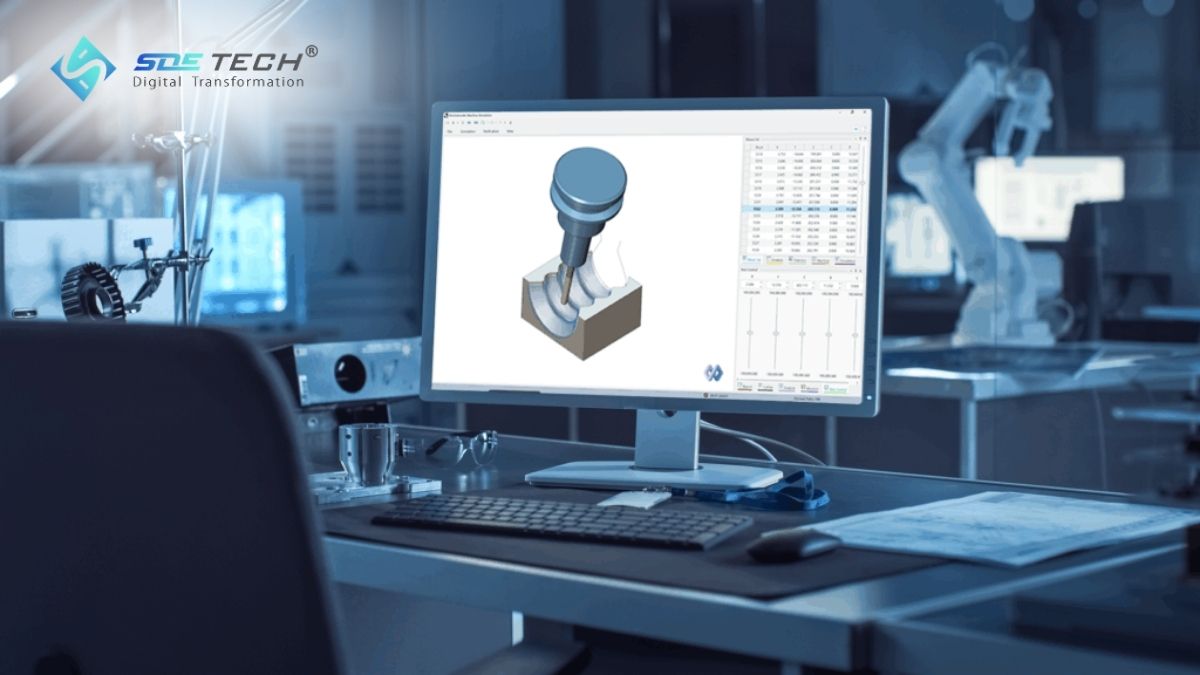
In the era of smart manufacturing, reducing programming time and ensuring absolute safety for CNC machines have become top priorities for precision engineering enterprises. The latest release, ModuleWorks 2026.04, introduces breakthrough solutions, particularly GPU-based simulation technology and the intelligent roughing feature VoluMill Smart Roughing. SDE Tech continues to update these technological trends to help businesses optimize CAM processes and enhance operational productivity.
1. Smarter Toolpaths: Optimization from Roughing to Finishing
1.1 Multi-axis roughing
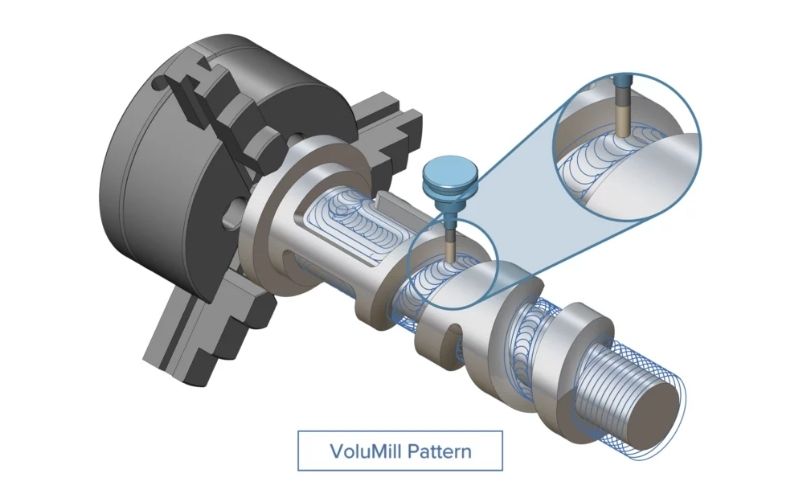
ModuleWorks introduces the VoluMill pattern for Area Roughing. Traditional offset patterns often fail in complex geometries such as corners, closed pockets, or pass-over transition areas, leading to tool overload, increased wear, and reduced surface quality.
VoluMill addresses this by monitoring chip load and engagement levels, automatically applying strategies such as trochoidal cutting or controlled boundary expansion to reduce load where necessary. As a result, the toolpath maintains a high and consistent cutting width ratio while allowing increased feed rates and better tool protection.
1.2 Automatic 3+2-Axis Roughing
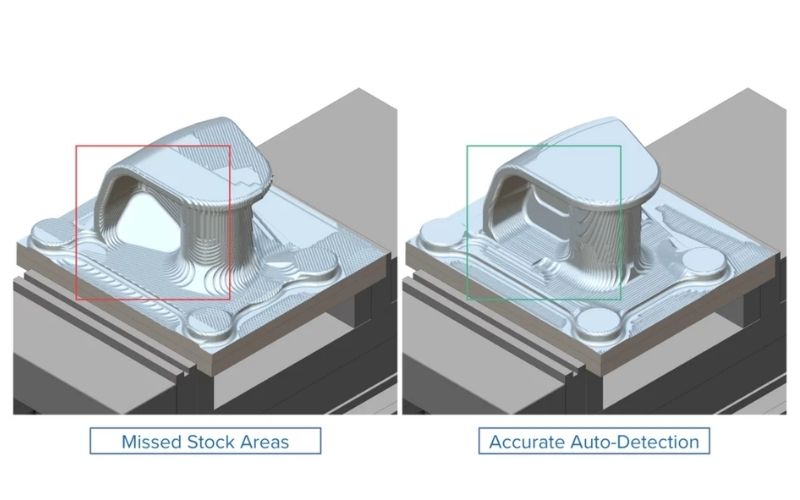
ModuleWorks introduces Stock Volume Based Machining Directions. Instead of manually checking machining directions and handling remaining stock regions, the system automatically analyzes removable material volume from multiple directions to select the optimal machining strategy. This significantly reduces setup time, minimizes errors from incorrect stock recognition, and ensures more consistent machining results.
1.3 Rotary Machining Roughing
VoluMill continues to ensure stable material removal rates, avoiding full-width cuts typically seen in narrow or enclosed geometries such as threads or extruded features. This results in smoother toolpaths, reduced cutting force spikes, and extended tool life—an important improvement for businesses prioritizing productivity while maintaining process stability.
1.4 Surface finishing enhancements
ModuleWorks introduces Constant Z Cuts for Wall Finishing. This feature allows users to precisely define constant-height passes without relying entirely on existing surface geometry. Even without suitable floor surfaces near machining areas, reliable finishing passes can still be generated, improving control over vertical wall surface quality.
1.5 3-axis mesh finishing
The Morph Between Guide Curves feature enables defining toolpaths using two guide curves, allowing smooth interpolation between them. This is significantly more flexible than traditional patterns like Parallel Cuts or Constant Cusp, especially for complex surfaces where minimizing unnecessary retracing is critical.
ModuleWorks 2026.04 also enhances Adaptive Roughing for thin-wall parts by separating zig-zag strategies for thin regions and one-way strategies for the rest, significantly reducing cycle time for thin-wall components.
Another notable feature is Optimized Lead-In for Offset Roughing, where the system automatically adjusts stock clearance based on local geometry. In narrow slots or small holes, clearance is reduced for shorter lead-ins, minimizing air cutting and excessive ramping; in open areas, standard clearance is maintained. This optimization reduces machining time without requiring extensive manual adjustments.
2. More Stable Turning with Constant Chip Thickness
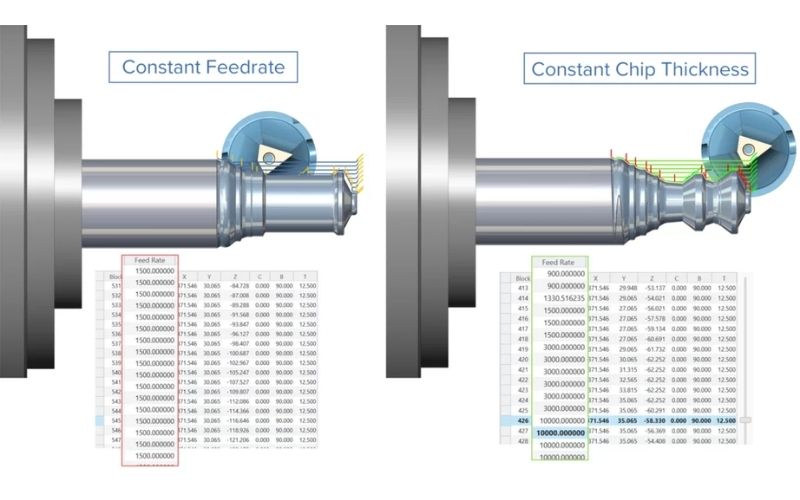
In turning operations, ModuleWorks 2026.04 introduces Constant Chip Thickness for High Dynamic Turning. When the engagement angle changes while feed rate remains constant, chip thickness becomes inconsistent, leading to unstable cutting forces, increased tool wear, and inconsistent surface finish.
This new solution maintains consistent chip thickness, stabilizing cutting forces, improving surface quality, reducing thermal stress on cutting edges, and enhancing chip evacuation. It is a critical improvement for high-quality turning applications requiring long-term process stability.
3. Simulation Accelerated by GPU
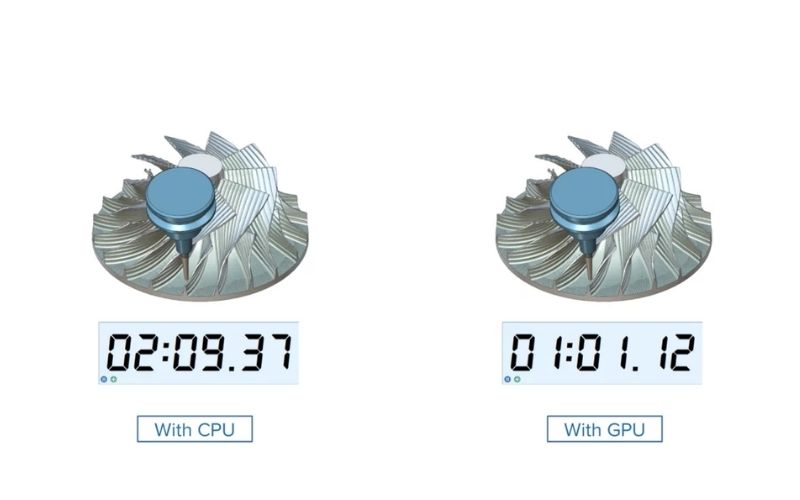
In machine simulation, ModuleWorks 2026.04 introduces GPU-Accelerated Material Removal. Previously, CPU-based material removal simulation could slow workflows, especially with complex toolpaths or continuous collision checks.
The new version leverages GPU acceleration to speed up stock updates and collision detection for milling operations, supporting both parametric and mesh-based tools. When unsupported scenarios occur, the system seamlessly falls back to CPU processing to ensure continuity. For businesses, this means faster setup-to-decision cycles, reduced simulation waiting time, and quicker production decisions.
4. NGSP WebApp: More Flexible Shopfloor Programming
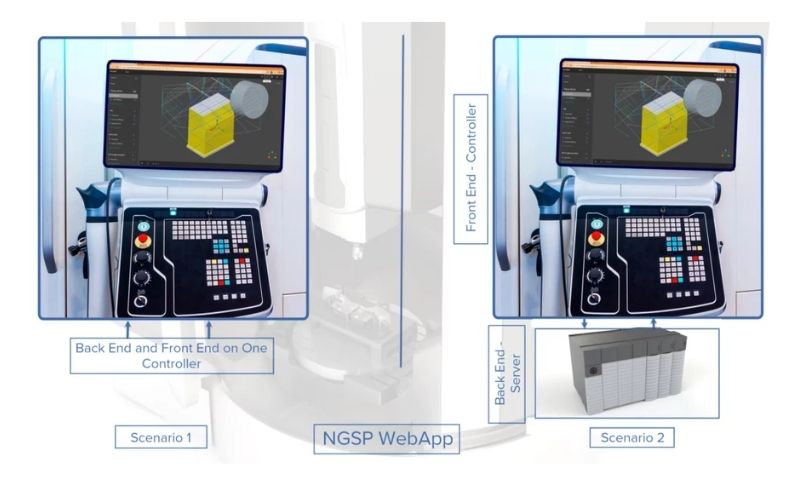
In automation, ModuleWorks 2026.04 introduces NGSP WebApp—a web-based version of Next-Generation Shopfloor Programming. Unlike the previous Windows-only WPF client, this new application runs on both Linux and Windows, requires no complex installation, and works across multiple devices and browsers. It also allows businesses to customize interface, branding, and language according to deployment needs.
This aligns with modern IT infrastructure trends where mobility, scalability, and cross-platform consistency are increasingly important.
5. Impact of ModuleWorks 2026.04 on Manufacturing Enterprises
Clearly, ModuleWorks 2026.04 is not just a feature update but a significant step toward smarter machining, faster simulation, and more flexible deployment.
- Toolpaths focus on cutting load control, stable chip load, and reduced manual intervention.
- Simulation benefits from GPU acceleration, shortening verification time.
- Automation leverages web-based deployment for easier scalability across devices and environments.
All these factors contribute to the same goal: reducing cycle time, increasing safety, improving efficiency, and helping businesses move closer to digital manufacturing.
6. ModuleWorks Solutions in Vietnam via SDE Tech
As a pioneer in digital transformation and industrial software solutions in Vietnam, SDE Tech continuously supports businesses in adopting the latest technologies. Leveraging innovations from ModuleWorks 2026.04, especially VoluMill technology, enables manufacturers to:
- Maximize machine performance.
- Reduce tooling costs.
- Ensure absolute machine safety.
ModuleWorks 2026.04 is not just a software update but a clear demonstration of the convergence between hardware power (GPU) and intelligent algorithms (VoluMill Smart Roughing). For businesses moving toward smart factories, these tools are essential to maintaining competitive advantage.
For in-depth consultation on CAD/CAM solutions and the latest simulation technologies, please contact the technical team at SDE Tech.
- Website: sde.vn
- Email: sales@sde.vn