Tiếng Việt
 日本語
日本語 한국어
한국어
In the era of precision manufacturing, operating CNC systems requires absolute control over both software and hardware. Even a minor mistake in programming or operation can lead to CNC machining errors, causing significant financial losses and production delays for businesses. Accurately identifying root causes and applying advanced simulation solutions such as MANUS is an essential step toward optimizing manufacturing productivity.
1. Common CNC machining errors that cause major losses for businesses
In real-world manufacturing environments, CNC machining errors often arise from inconsistencies between programmed data and actual machine operation. Below are typical issues frequently encountered by mechanical manufacturing companies.
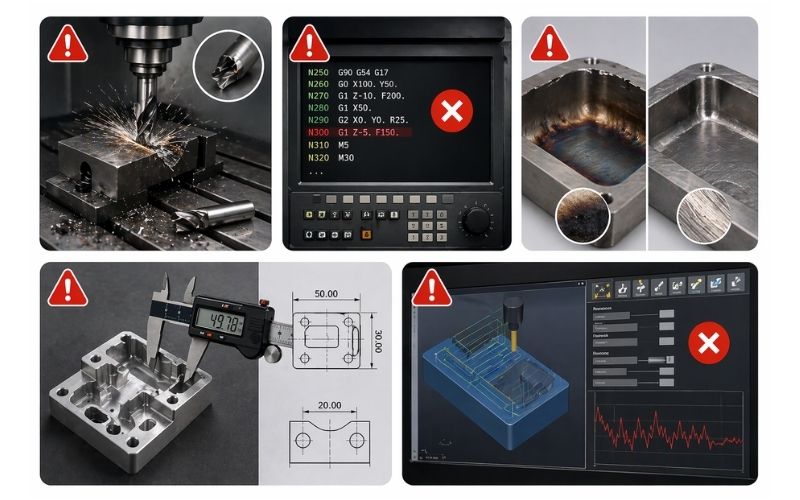
1.1. Machine collisions and tool breakage
Collisions can occur between the spindle and the workpiece, between cutting tools and fixtures, or among moving machine components. These are mainly caused by incorrect coordinate setup, inaccurate tool dimension input, or errors in G-code that conventional CAM simulation software fails to detect.
1.2. Incompatible G-code causing unexpected machine stoppage
Different CNC systems (such as Fanuc, Siemens, and Heidenhain) follow their own command structures. If the post processor is not properly configured, the generated G-code may contain unsupported commands, leading to sudden machine stoppage during operation.
1.3. Burnt surfaces, deformation, or poor surface finish
This issue is typically related to improper cutting parameters. Excessively high spindle speeds or low feed rates generate excessive heat due to friction, causing surface burning or thermal deformation in sensitive materials. Conversely, unstable cutting conditions can lead to chatter, resulting in poor surface finish quality.
1.4. Dimensional inaccuracies compared to design specifications
Dimensional deviation is one of the most difficult CNC machining errors to control. It may result from tool wear over time, thermal expansion of machine components, or deformation of the fixturing system under cutting forces. Without accurate tool compensation or control of machining dynamics, parts may easily fall outside tolerance limits.
1.5. Unexpected machine behavior due to control software errors
In some cases, CNC machines execute unusual toolpaths that do not match the programmer’s intent. This typically stems from data conflicts between CAM software and the actual machine controller. Incorrect interpolation commands or improper handling of cycles can cause deviations from the intended machining path.
2. Root causes of CNC machining errors
To effectively eliminate CNC machining errors, it is necessary to analyze weaknesses across the entire workflow—from design to actual machining.
2.1. Lack of real-machine simulation before machining
Many engineers stop at CAM simulation, which only verifies toolpaths based on geometric theory. However, it does not fully reflect the actual G-code behavior after post-processing. The absence of a true G-code simulation environment is the biggest gap leading to unexpected collisions.
2.2. Post processor not optimized for specific machines
Each CNC machine has unique axis limits, speeds, and mechanical structures. Using generic or poorly optimized post processors leads to inaccurate machining data, causing incompatibility issues and reduced precision—especially in complex 5-axis operations.
2.3. Cutting parameters not based on machine dynamics
Cutting parameters are often selected based on experience or material charts, without considering the machine’s real-time load capacity. Maintaining a constant feed rate without accounting for changes in Material Removal Rate (MRR) can either waste machine capacity or overload cutting tools.
3. MANUS ecosystem: A comprehensive solution to eliminate CNC machining errors
To address these challenges, the MANUS software ecosystem is designed to create a fully integrated and safe production workflow, eliminating CNC machining errors from the preparation stage.
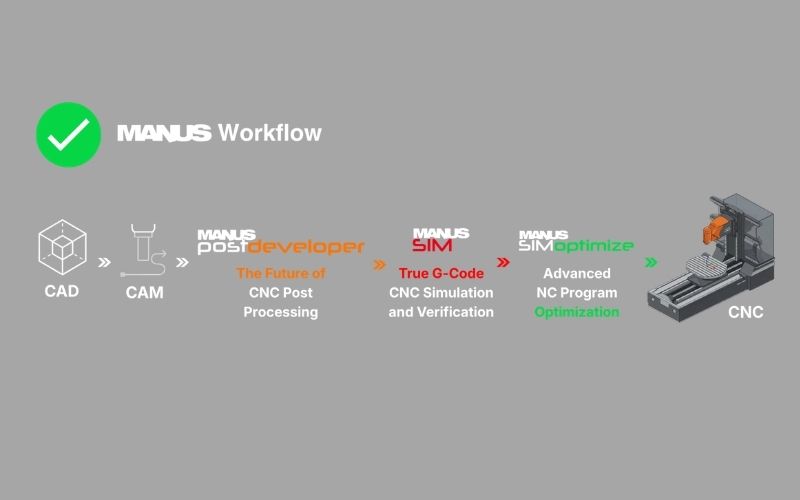
3.1. MANUSpost Developer – Accurate post processor for all CNC systems
MANUSpost Developer is more than a simple format converter. It allows deep customization to match the machine’s dynamics and specific command structures. Whether operating 3-axis or complex multi-axis machines, MANUSpost ensures optimal and fully compatible G-code output.
3.2. MANUSsim – Real G-code simulation for collision detection
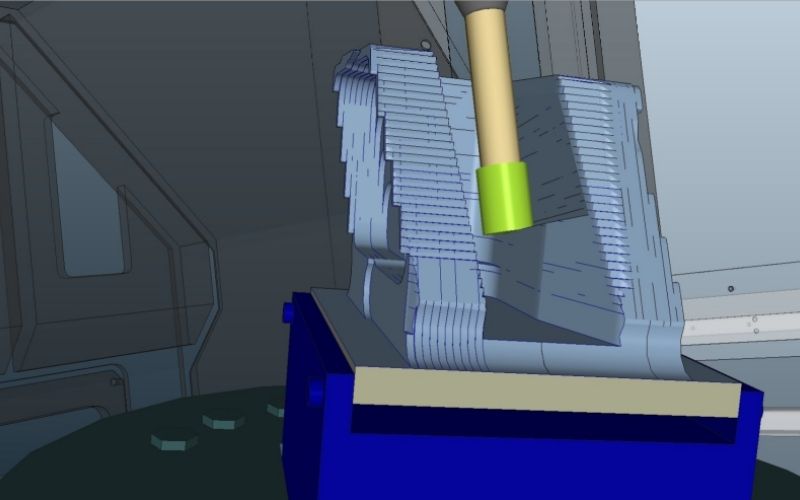
Unlike CAM simulation, MANUSsim simulates the actual G-code executed by the CNC machine. It creates a complete digital twin of the machine, including fixtures, tools, and workpieces. Engineers can detect collisions, gouging, or excess material issues before running the actual machine.
3.3. MANUSsim Optimize – Toolpath optimization for efficiency and tool life
MANUSsim Optimize automatically adjusts feed rates based on actual cutting conditions. It increases speed in light cutting areas and reduces it in heavy cutting zones, improving machining time by 20–50% while enhancing surface quality and tool lifespan.
4. Key benefits of implementing MANUS in manufacturing
Investing in the MANUS ecosystem delivers direct business value by controlling CNC machining errors.
- Eliminate collision risks and machine damage: Verified G-code ensures near-zero collision risk, reducing repair costs and downtime.
- Reduce machine setup and verification time: Operators can confidently run machines at full speed from the first attempt.
- Ensure superior surface quality and precision: Optimized cutting conditions minimize vibration and improve dimensional stability.
- Increase productivity and reduce operating costs: Shorter cycle times and extended tool life significantly improve efficiency.
5. Implementation process of the MANUS ecosystem
To achieve optimal results, implementing MANUS requires a structured and professional approach.
5.1. CNC system assessment and production needs analysis
Experts evaluate the current CNC system, identify control platforms, and analyze typical products to determine key issues and common errors.
5.2. Post processor setup and customization
Based on collected data, engineers develop and fine-tune post processors to ensure full compatibility with each machine’s configuration.
5.3. Simulation setup and technical training
Digital twins of CNC machines are created, and engineers are trained to use simulation tools effectively, analyze reports, and optimize machining strategies.
6. Frequently asked questions about CNC errors and MANUS
Why use MANUSsim if CAM already has collision detection?
CAM simulations rely on intermediate data (CL-data), while CNC machining errors often originate from final G-code. MANUSsim simulates actual machine-executed G-code, detecting errors missed by CAM.
Can MANUSpost support older CNC machines?
Yes. MANUSpost is highly flexible and can be customized even for older machines with strict command requirements.
Does MANUSsim Optimize risk damaging machines at high speeds?
No. The algorithm considers machine load limits and material properties, ensuring safe speed adjustments under all conditions.
Controlling and preventing CNC machining errors is not only a technical issue but also a critical factor in maintaining competitiveness. By implementing the MANUS ecosystem—from precise post-processing to G-code simulation and performance optimization—businesses can achieve error-free production, maximize profits, and strengthen their position in the precision manufacturing industry.
- Website: sde.vn
- Email: sales@sde.vn