Tiếng Việt
 日本語
日本語 한국어
한국어
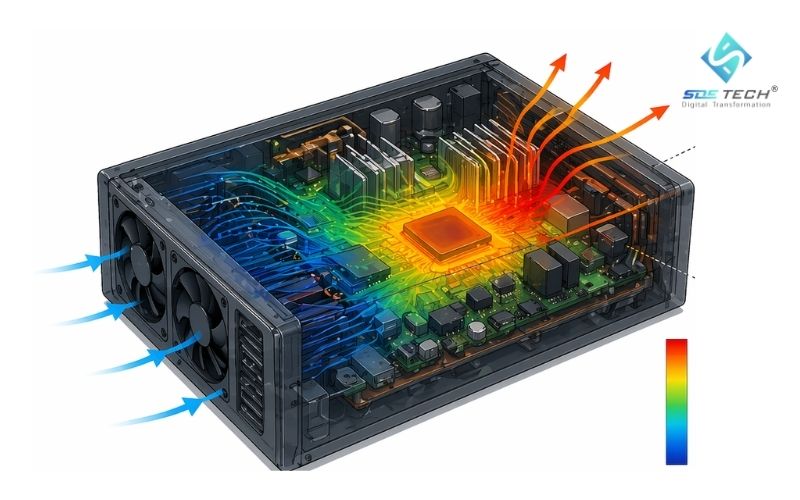
In the context of rapidly advancing technology, electronic devices are becoming increasingly compact while delivering higher processing performance. This trend leads to a significant rise in heat density per unit area, posing major challenges for engineers in maintaining safe operating temperatures. The application of CFD simulation in the electronics industry has become a key solution, enabling accurate prediction and control of thermal-fluid phenomena from the conceptual design stage.
1. The importance of CFD simulation for modern electronic devices
Thermal management is no longer simply about installing a fan or a heat sink. It is a complex analytical process involving the interaction between fluid flow and hardware structures.
1.1. Thermal challenges in device miniaturization trends
Miniaturization is rapidly advancing across all sectors, from smartphones and laptops to industrial control systems. As internal space becomes constrained, natural airflow is restricted, creating thermal hotspots. The use of CFD simulation in the electronics industry allows engineers to analyze airflow behavior in confined spaces in detail, enabling optimized component layout to enhance convective cooling performance.
1.2. Impact of thermal management on semiconductor reliability and lifespan
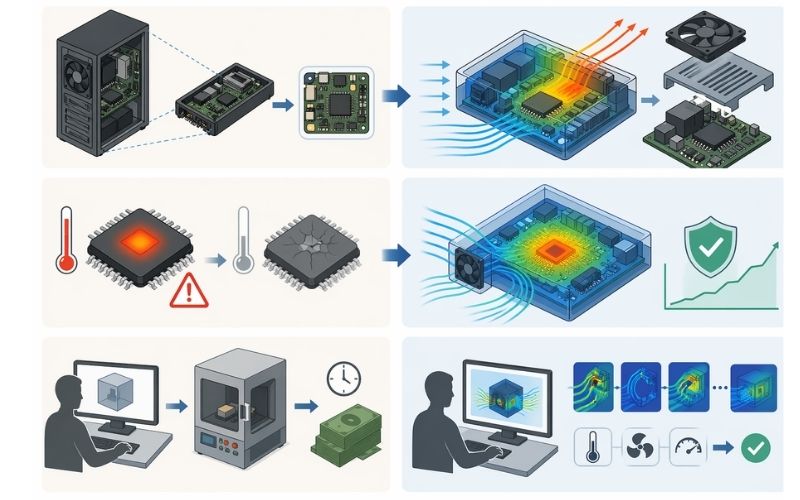
According to physical principles, the lifespan of semiconductor components is inversely proportional to their operating temperature. Excessive temperature rise not only degrades performance but can also cause permanent physical damage. Effective thermal management through simulation ensures that critical components such as CPUs, GPUs, and power MOSFETs operate within safe thermal limits.
1.3. Why CFD simulation is indispensable in electronics R&D processes
In traditional R&D workflows, thermal issues are often identified only during physical prototyping, resulting in costly design modifications and tooling adjustments. CFD simulation for electronic devices serves as a virtual laboratory where even the most extreme operating scenarios can be evaluated in advance.
2. Key applications of CFD in electronics and semiconductor industries
Thermal-fluid simulation systems can be applied at multiple levels of electronic products, from individual components to large-scale systems.
2.1. Airflow and natural/forced convection simulation within enclosures
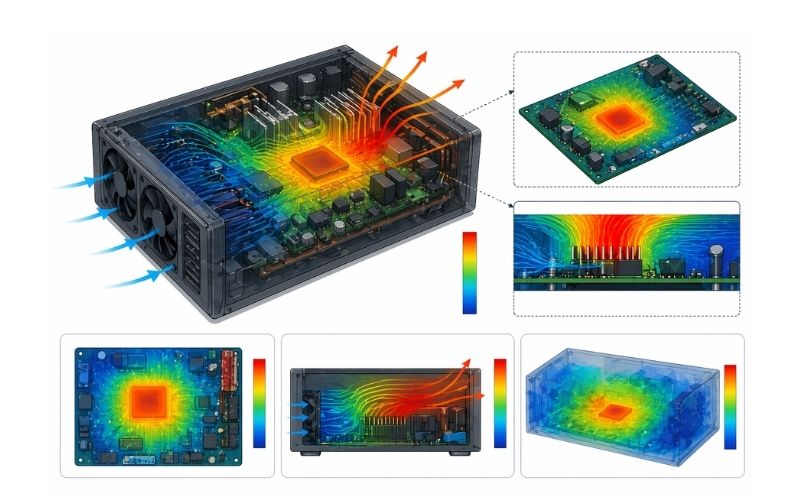
The arrangement of heat-generating components and ventilation openings directly impacts cooling efficiency. Through CFD simulation for the electronics industry, engineers can visualize airflow velocity vectors and pressure distribution inside device enclosures.
2.2. Optimization of heat sink design and fan placement
An efficient heat sink design requires a balance between surface area and flow resistance. CFD simulation enables performance comparison among different fin geometries such as straight fins, pin fins, and wavy structures. It also determines optimal fan placement to maximize airflow through critical thermal zones, avoiding flow blockage.
2.3. Thermal analysis of PCBs and surface-mounted components
Modern printed circuit boards (PCBs) consist of multilayer structures with complex copper traces that act as secondary heat conduction paths. CFD simulation for the electronics industry supports analysis of heat conduction through copper layers and vias. This is especially critical for high-power surface-mounted devices (SMDs), where heat dissipation largely depends on copper area.
2.4. Liquid cooling simulation for data centers and EV charging stations
For high power-density systems such as data center servers or EV charging stations, air cooling is no longer sufficient. Liquid cooling or immersion cooling becomes essential. CFD simulation helps design cooling blocks, optimize piping systems, and ensure uniform temperature distribution across the entire liquid cooling system.
3. Key benefits of simulation over physical testing
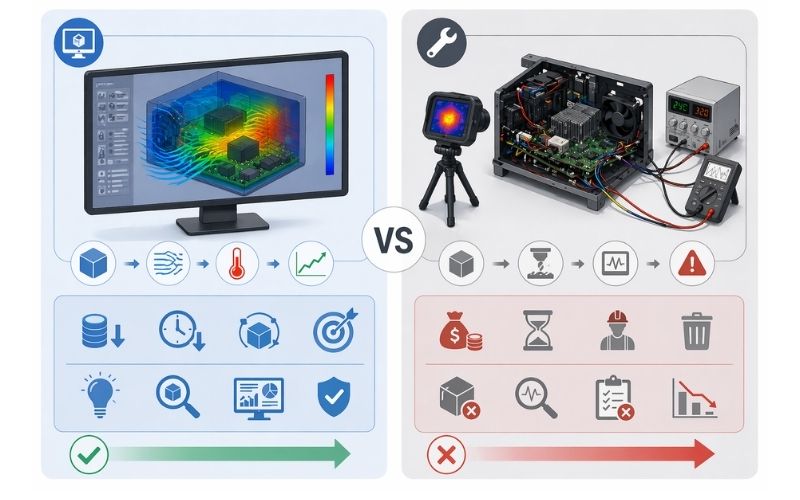
Transitioning from experimental methods to digital simulation delivers significant economic and technical advantages.
- Hotspot visualization: CFD enables internal visualization of flow and heat accumulation zones that are difficult to fully capture through physical measurements.
- Reduced prototypes & lab costs: Hundreds of design scenarios can be tested virtually at low cost, significantly reducing the number of physical prototypes and R&D expenses.
- Shorter time-to-market: Fast simulation cycles (from hours to days) accelerate design iterations and product launch timelines.
4. Breakthrough meshless CFD technology with Particleworks for electronics
At SDE Tech, we provide Particleworks – a simulation solution based on the particle method (MPS – Moving Particle Simulation), offering a fundamentally different approach compared to traditional CFD.
4.1. Simulation of oil/liquid cooling in high-power electronic systems
For high-power inverters or electric motors, oil cooling simulation requires accurate modeling of free-surface interactions. Particleworks excels at simulating oil jets directly impinging on components or immersion cooling processes, where traditional meshing methods are extremely challenging or infeasible.
4.2. Accurate analysis of liquid leakage and ingress
One critical challenge in electronics is ensuring water resistance (IP rating). Using CFD simulation for the electronics industry with particle-based methods, engineers can simulate water ingress scenarios through enclosure gaps or connectors. This enables validation of sealing performance without physical immersion testing.
The MPS method in Particleworks completely eliminates the complex meshing step, which typically accounts for 50–70% of total simulation time in traditional CFD. This is particularly advantageous for simulating moving components such as cooling fans or splashing fluid flows.

5. SDE Tech’s advanced CFD consulting and implementation workflow
SDE Tech not only provides software licensing but also acts as a strategic partner in transferring simulation workflows to enterprises.
- Requirement assessment & software selection: Analyze product-specific thermal characteristics to recommend suitable tools such as Particleworks or Simcenter FloEFD, ensuring optimal performance and cost efficiency.
- Model setup & process standardization: Support accurate definition of boundary conditions, heat sources, and materials, while standardizing workflows for stable internal deployment.
- Training & post-sales support: Provide training from basic to advanced levels and continuous technical support to ensure the software delivers real business value.
6. Frequently asked questions about thermal simulation in electronics
What is the accuracy of CFD simulation compared to real-world results?
If input parameters such as heat load, material properties, and boundary conditions are accurately defined, the deviation between CFD simulation and experimental results is typically below 5%. This level of accuracy is fully acceptable in industrial design standards.
Does CFD simulation require high-end computing hardware?
It depends on model complexity. However, with modern technologies such as GPU computing integrated into the software solutions provided by SDE Tech, simulations can now be performed efficiently even on mid-range workstations.
How to simulate thermal behavior in fanless mobile devices?
For passive cooling devices, CFD focuses on natural convection and thermal radiation analysis. The software calculates how heat transfers from components to the enclosure and dissipates into the surrounding environment, enabling optimization of enclosure materials and internal layout.
The application of CFD simulation in the electronics industry is an essential step toward enhancing product quality and strengthening technological capabilities. With the support of SDE Tech, businesses gain access to world-class simulation solutions such as Particleworks, transforming thermal challenges into competitive advantages in the electronics and semiconductor markets.
- Website: sde.vn
- Email: sales@sde.vn
- Hotline/Zalo: 085 256 2615 – 0909 107 719