Tiếng Việt
 日本語
日本語 한국어
한국어
In traditional CFD simulations, mesh generation is often the biggest bottleneck, consuming significant time and introducing potential inaccuracies. The emergence of particle-based methods such as MPS and SPH has ushered in the era of meshless CFD, effectively addressing complex problems involving free-surface phenomena. Together with SDE Tech, let’s take an in-depth look at the algorithmic differences between MPS and SPH, and explore why MPS (Particleworks) has become the leading choice for industrial applications today.
1. Overview of Particle-based Simulation Methods
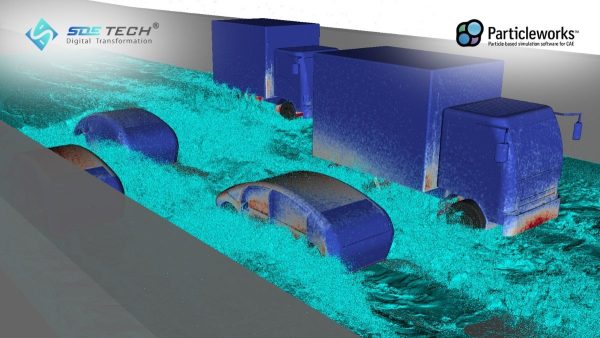
Unlike traditional Eulerian approaches (which rely on fixed meshes), particle-based methods adopt a Lagrangian approach. In this framework, fluids are represented by millions of freely moving particles. Each particle carries complete physical properties such as velocity, pressure, and temperature.
The core advantage of particle methods lies in their ability to handle problems involving extremely large surface deformations or complex rotational motions without concerns about mesh distortion. This is precisely the foundation that enables enterprises to optimize their R&D processes and significantly shorten the cycle from design to experimental validation.
2. What is the MPS (Moving Particle Semi-implicit) Method?
MPS is a semi-implicit particle method specifically designed for incompressible fluid flows, such as oil or water.
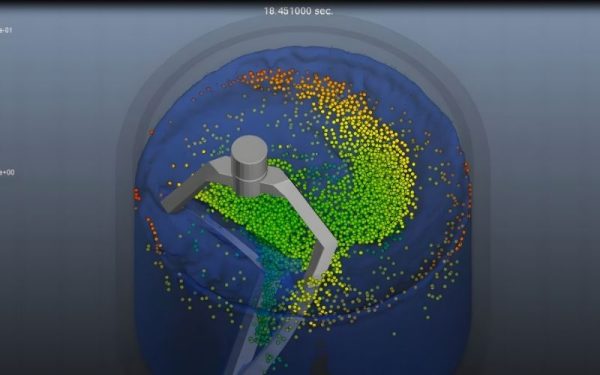
Key algorithmic characteristics: MPS solves the pressure field using an implicit approach based on the Poisson equation. This formulation strictly enforces zero compressibility of the fluid. As a result, MPS excels at handling surface pressure phenomena and maintaining the stability of fluid particles, even under highly demanding and extreme flow conditions.
3. What is the SPH (Smoothed Particle Hydrodynamics) Method?
SPH is one of the earliest particle-based simulation methods, originally developed for astrophysical problems and later adapted for fluid engineering applications.
Key algorithmic characteristics: Unlike MPS, traditional SPH is a fully explicit method. It computes pressure based on an Equation of State (EOS). However, this approach inherently makes the fluid weakly compressible. To maintain incompressibility, SPH requires additional and often complex correction algorithms; otherwise, the simulation results are prone to pressure fluctuations and numerical noise.
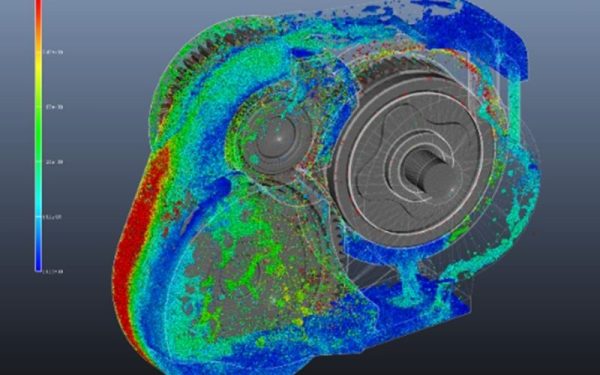
4. So sánh MPS và SPH
Based on established technical research, although both are particle-based methods, fundamental differences in their numerical formulations lead to dramatically different real-world performance:
| Comparison Criteria | MPS Method (Particleworks) | SPH Method |
|---|---|---|
| Pressure solving approach | Semi-implicit, solved via the Poisson Equation | Fully explicit, based on the Equation of State (EOS) |
| Fluid compressibility | Strictly incompressible | Weakly compressible |
| Time step (Δt) | Much larger (more stable) | Significantly smaller |
| Computational performance | 10–100× faster | Slower due to strict time-step limitations |
| Pressure stability | Very high, minimal noise, smooth free surfaces | Prone to pressure fluctuations, often resulting in “pitted” surfaces |
Why is the time step (Δt) so important?
In numerical simulation, the time step determines how much physical time is advanced in each computational iteration. According to technical publications from Particleworks Europe, by solving the Poisson equation, the MPS method allows the use of time steps 10 to 100 times larger than SPH while maintaining mathematical stability. In practical terms, this means that for the same simulation—such as modeling lubricant flow in a gearbox over 1 second of real time—MPS can complete the analysis in just a few hours, whereas SPH may require several days to achieve comparable results.
5. Why Meshless CFD Is the Key to R&D Optimization in 2026?
Eliminating the meshing process delivers breakthrough advantages for manufacturing and engineering enterprises:
- Up to 90% reduction in pre-processing time: Engineers can import CAD models directly, without worrying about mesh errors or time-consuming mesh refinement in narrow gaps and sharp corners.
- Superior accuracy in splashing and free-surface problems: MPS accurately captures fine droplets and complex free-surface behavior—scenarios where traditional mesh-based CFD often loses detail due to insufficient mesh resolution.
- Maximized GPU computing power: Modern MPS solvers are designed to run entirely on NVIDIA GPUs, delivering performance gains of tens of times compared to CPU-based computation.
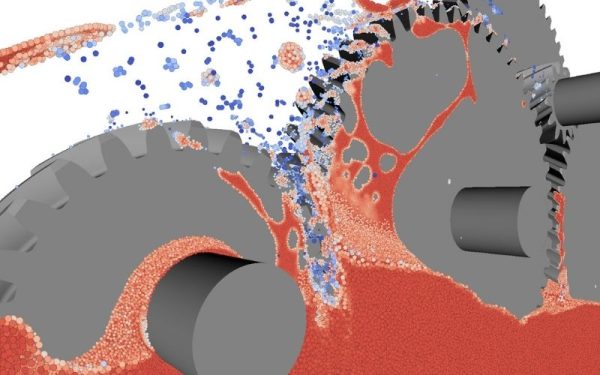
6. Typical Industrial Applications of MPS and SPH
6.1 Automotive Industry
Wading Simulation: MPS enables accurate prediction of water splash levels reaching sensitive electronic components of electric vehicles (EVs) when driving through puddles.
E-axle Cooling and Lubrication: Analyzing the lubricating oil flow as it penetrates high-speed gear meshes to optimize drivetrain performance.
6.2 Machinery Manufacturing and Energy Industry
Industrial Gearbox Lubrication: Tracking oil splash behavior to ensure all components are properly lubricated, preventing overheating and failure.
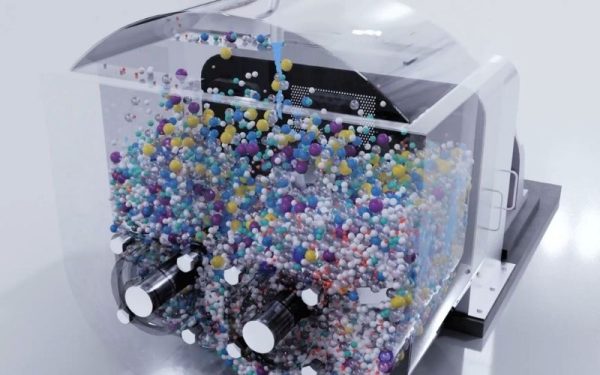
Chemical/Food Mixing: Simulating complex rotating impellers in mixing tanks without the need for dynamic meshing.
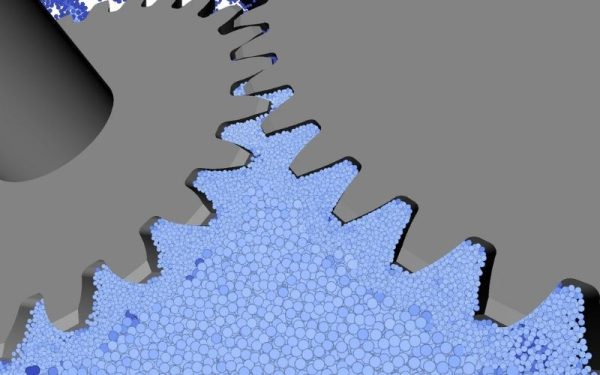
7. Particleworks Solution – Realizing the Power of MPS Technology
In Vietnam, SDE Tech provides the Particleworks solution—the most advanced particle-based simulation software currently available, built on the MPS method
Why choose Particleworks?
- Breakthrough algorithms: Fully leverages the Poisson equation and large time steps, making industrial-scale simulations feasible within practical timeframes.
- Superior user interface: Eliminates complex mathematical settings, allowing engineers to focus on solving engineering problems.
- Multiphysics integration: Easily connects with structural analysis software to perform fluid–structure interaction (FSI) simulations.
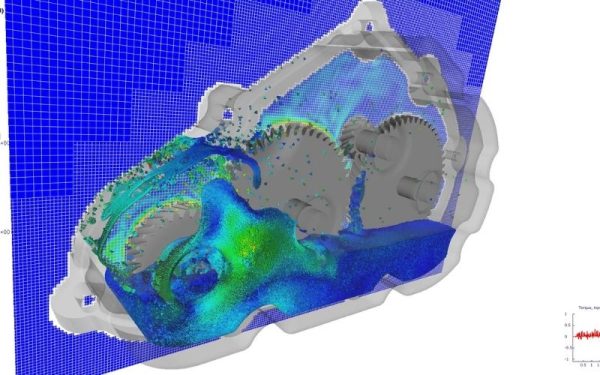
8. SDE Tech – A Leading Partner in Particle Simulation Technology Transfer
Deploying a meshless simulation system such as MPS/SPH is not just about purchasing software, but about building a robust and accurate R&D process. SDE Tech is proud to accompany Vietnamese enterprises through:
- In-depth technical consulting: Analyzing and selecting the most suitable method (MPS or SPH) based on the specific characteristics of the customer’s products.
- Technology mastery training: Transferring internationally standardized simulation workflows from renowned global vendors.
- Customized post-processor support: Helping enterprises generate intuitive and insightful reports to support design optimization.
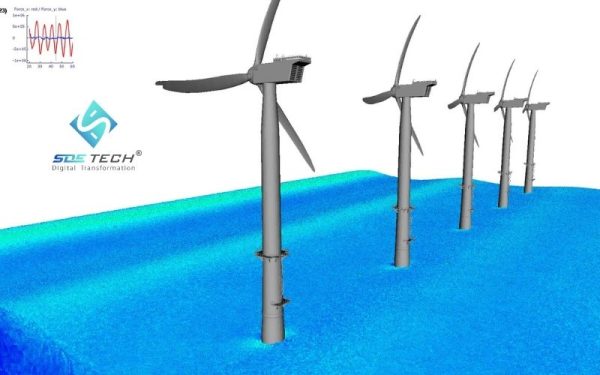
9. Frequently Asked Questions
9.1 When should I use MPS and when should I use SPH?
Although both are particle-based methods, MPS (Moving Particle Semi-implicit) is typically optimal for incompressible flows with extremely complex free surfaces (such as gearbox lubrication or automotive wading simulations). SPH (Smoothed Particle Hydrodynamics), on the other hand, is powerful for high-speed dynamics, compressible flows, or physical impact problems (such as dam breaks or tsunamis).
9.2 Do particle simulations require extremely high computer configurations?
Because interactions among millions of particles must be computed, MPS/SPH simulations are relatively resource-intensive. However, modern software (such as Particleworks) has been highly optimized for GPU-based solvers (graphics cards). Using GPUs can accelerate computation by tens of times compared to traditional CPUs, enabling complex simulations to be performed even on standard workstations.
*Content compiled from: Particleworks.com
Understanding the differences between MPS and SPH is the first step for enterprises to choose the right simulation tool. With its decisive advantages in time step size and pressure stability thanks to the Poisson equation, the MPS method (Particleworks) is increasingly establishing itself as a powerful enabler for the era of digital manufacturing. Contact SDE TECH today to receive consultation and an in-depth demo of the Particleworks solution!
- Email: sales@sde.vn
- Hotline/Zalo: 085 256 2615 – 0909 107 719