Tiếng Việt
 日本語
日本語 한국어
한국어
The application of PLM for manufacturing with Siemens Teamcenter has become a critical requirement for enterprises seeking faster innovation, tighter cost control, and standardized data management. In this article, SDE Tech provides an in-depth analysis of the Teamcenter platform—the “single source of truth” that enables end-to-end product lifecycle management and delivers sustainable competitive advantage.
1. What is PLM for Manufacturing?
PLM (Product Lifecycle Management) is a product lifecycle management platform developed by Siemens that enables organizations to manage all aspects of a product’s lifecycle—from initial concept and design to manufacturing, service, and end-of-life. At its core, PLM provides a centralized environment where teams can collaborate, manage complex product data, automate workflows, and make smarter decisions based on accurate, real-time information.

2. The Importance of a PLM Solution
As a comprehensive management system, Teamcenter connects previously disconnected systems and processes across the organization, breaking down information silos that often slow product development and manufacturing. By doing so, it strongly supports digital transformation initiatives and enables enterprises to respond quickly to constantly evolving market demands.

3. Why Does PLM Play a Core Role in Smart Manufacturing?
Modern manufacturing is no longer simply about producing goods; it is about effectively managing information across departments, geographic locations, and stakeholders. This is precisely the core value that a PLM system for manufacturing delivers.
By centralizing product data—including CAD files, bills of materials (BOMs), specifications, requirements, and change histories—companies can reduce errors, avoid duplicated work, and accelerate time to market. Teamcenter’s capabilities make it a strategic enabler of smart manufacturing, where digital information drives better decision-making, stronger collaboration, and more effective innovation.
4. Core Capabilities of Siemens Teamcenter in a PLM System
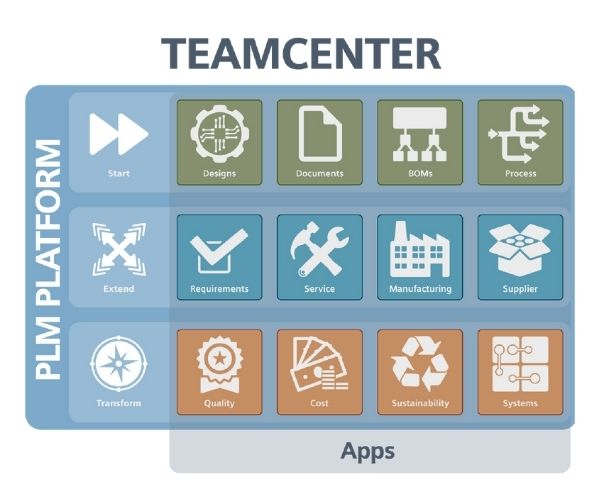
To deliver tangible business value, Siemens Teamcenter provides a comprehensive and versatile toolset that supports every stage of manufacturing.
4.1 Centralized Data Management
Teamcenter offers a secure repository for all product data, from CAD design files to technical documentation, enabling version control, full traceability, and access governance. This ensures that engineers and stakeholders always work with the most accurate and up-to-date information.
4.2 Multi-CAD Data Integration
The platform integrates seamlessly with multiple CAD systems such as NX, Solid Edge, CATIA, and other tools. This multi-CAD capability allows teams to work in different authoring environments while maintaining a unified data backbone, ensuring fully synchronized PLM management for manufacturing.
4.3 Change and Configuration Management
Teamcenter automates and standardizes Engineering Change Requests (ECRs), Engineering Change Orders (ECOs), and product configurations. Robust version and change control reduces delays and improves the accuracy of the final product.
4.4 Workflow Automation
Standard approval processes, task assignments, and quality controls are automated to improve operational efficiency and transparency. This helps organizations minimize manual effort and significantly reduce avoidable errors.
4.5 Bill of Materials (BOM) Management
The system supports multiple BOM views, including engineering, manufacturing, and service BOMs. These views remain synchronized throughout the development lifecycle, ensuring alignment across teams from design through shop-floor production.
4.6 Quality and Compliance Management
By integrating tools such as FMEA, CAPA, audits, and regulatory documentation, Teamcenter embeds quality into the product from the earliest stages. This capability is essential for a sustainable PLM strategy in manufacturing.
4.7 Supplier Collaboration
Teams can securely share data with suppliers and external partners, improving coordination, reducing errors, and accelerating innovation cycles.
5. The Significance of PLM System Integration
Integration is one of the most powerful aspects of Teamcenter. So what does integration in PLM for manufacturing actually mean?
Teamcenter integration refers to the software’s ability to connect and work seamlessly with other enterprise systems, including CAD/CAM tools, ERP systems, and various business applications. Through open standards and flexible APIs, Teamcenter can link critical systems across the entire organization.
This means that product data and processes flow consistently between systems, supporting production planning, procurement, quality management, cost control, and more—without manual intervention. With this level of integration, organizations can eliminate data silos, enable better decision-making, and accelerate the product development lifecycle.
6. Strategic Benefits of Implementing Siemens Teamcenter
Deploying a PLM solution for manufacturing delivers clear and measurable improvements to overall business performance.
- Improved collaboration: Teamcenter enables cross-functional teams—from design and engineering to quality and supply chain—to work in sync, share insights, and drive innovation more effectively.
- Accelerated development cycles: By automating workflows and centralizing product data, decisions are made faster and with greater confidence, resulting in shorter product development timelines.
- Enhanced product quality: Built-in quality and compliance processes help teams identify issues early and maintain standards consistently throughout the entire product lifecycle.
- Cost optimization: By reducing rework, eliminating redundant activities, and improving data accuracy, Teamcenter helps lower both operational and development costs.
- Scalability and flexibility: Whether deployed on-premises or in the cloud, Teamcenter scales with your business, supporting everything from small teams to global enterprises with increasing levels of complexity.
7. SDE Tech – Your Trusted Partner for Successful PLM Implementation
While Siemens Teamcenter offers extremely powerful capabilities, its true value is only realized through effective implementation and seamless integration into your business ecosystem. This is where SDE Tech plays a critical role. With deep expertise in PLM for manufacturing and extensive implementation experience, SDE Tech helps enterprises unlock the full potential of Teamcenter. Our services include:
- End-to-end PLM implementation: From initial planning and system configuration to comprehensive training and dedicated technical support.
- Custom integration: Ensuring Teamcenter operates seamlessly with existing CAD, ERP, and other enterprise systems.
- Automation and optimization: Streamlining engineering, manufacturing, and compliance processes to achieve maximum operational efficiency.
8. Frequently Asked Questions about PLM for Manufacturing
Below are concise answers to some of the most common questions enterprises have when exploring a PLM system.
8.1 Do small and medium-sized enterprises really need PLM for manufacturing?
Regardless of company size, systematic product data management is a critical success factor. For smaller enterprises, PLM helps establish a professional management foundation from the outset, preventing costly errors during scale-up and ensuring consistency across design and engineering data.
8.2 How does Teamcenter help reduce manufacturing costs?
By ensuring accurate BOM management and enforcing strict change control processes, Teamcenter minimizes production errors caused by using incorrect design versions. In addition, early detection of engineering issues during the simulation and design phases significantly reduces the costs associated with rework and scrap in actual production.
8.3 How long does it typically take to implement a Teamcenter system?
Implementation time depends on the project scope and the complexity of the enterprise’s processes. However, with a standardized deployment roadmap and support from SDE Tech’s experts, companies can shorten implementation timelines and quickly put the system into operation to optimize ROI.
Siemens Teamcenter is a key platform that enables enterprises to manage the entire product lifecycle and accelerate digital transformation under increasing competitive pressure. Partnering with SDE Tech allows you to fully leverage the power of this PLM solution for manufacturing—building a connected, intelligent manufacturing ecosystem and achieving sustainable business efficiency.
SDE Tech Contact Information:
- Email: sales@sde.vn
- Hotline/Zalo: +84 85 256 2615 – +84 909 107 719