Tiếng Việt
 日本語
日本語 한국어
한국어
In the mechanical machining industry, the pressure to reduce production time while still ensuring part quality is a challenge that most workshops face every day. Rapid tool wear, machine downtime for tool changes, and the need to reprogram toolpaths for complex parts are common issues. These are exactly the problems that VoluMill for ZW3D was designed to solve. In this article, SDE TECH provides comprehensive technical information, practical benefits, and implementation guidance for deploying VoluMill ZW3D in manufacturing businesses.
1. What is VoluMill for ZW3D?
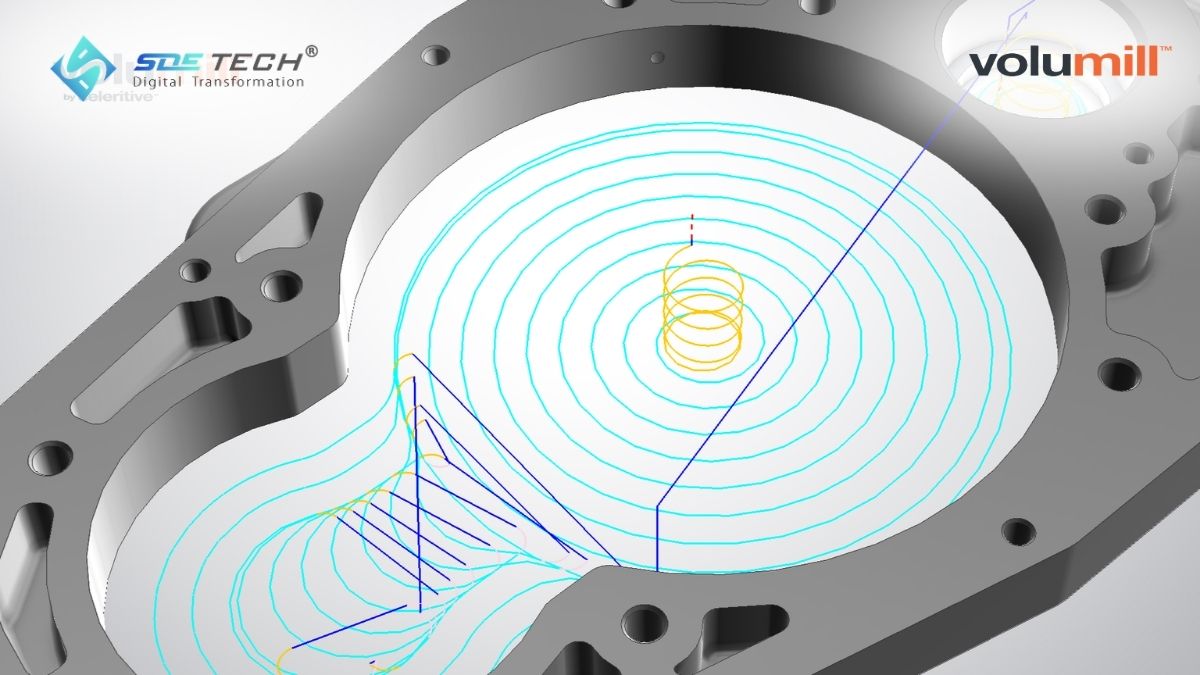
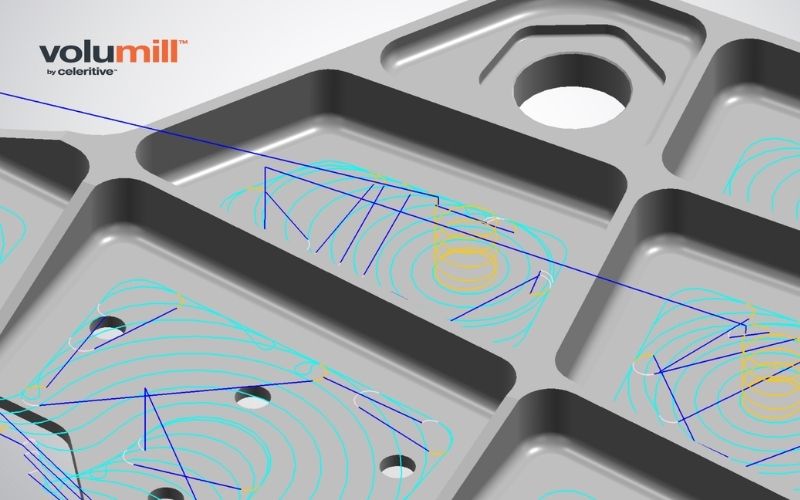
VoluMill for ZW3D is a High-Speed Machining (HSM) add-on module integrated directly into the ZW3D CAM environment. Instead of generating toolpaths using traditional methods with multiple abrupt direction changes, VoluMill applies an advanced toolpath calculation algorithm based on controlling the Material Removal Rate (MRR) throughout each segment of the cutting path.
As a result, the cutting tool experiences significantly less thermal shock and mechanical stress, leading to a noticeable increase in tool life. Cutting speeds can be increased safely, while the surface quality of machined parts is also improved.
2. How VoluMill for ZW3D Works
To understand why VoluMill for ZW3D delivers superior machining performance, it is important to look at how this software handles toolpaths differently from conventional CAM strategies.
2.1 Material Removal Rate (MRR) Control
In traditional CNC machining, toolpaths are generated mainly based on part geometry and machining contours, without actively controlling instantaneous cutting forces along the toolpath. As a result, when the tool enters internal corners or changes direction, the amount of material engagement increases suddenly — causing higher cutting forces, increased heat generation, and accelerated localized tool wear.
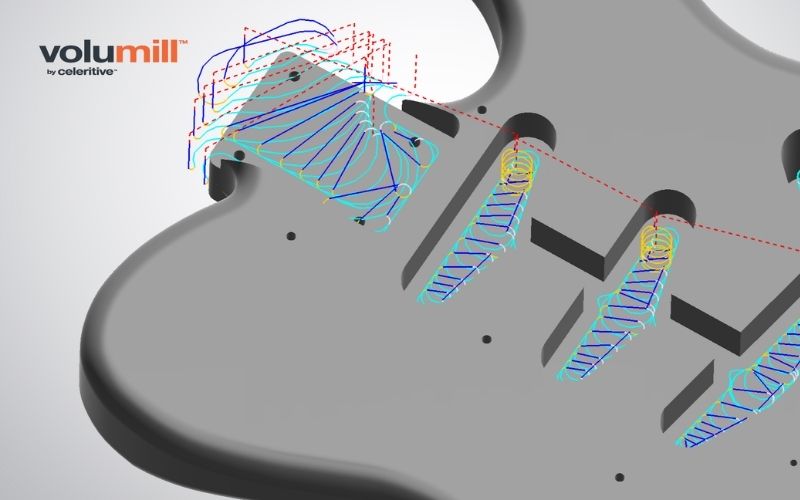
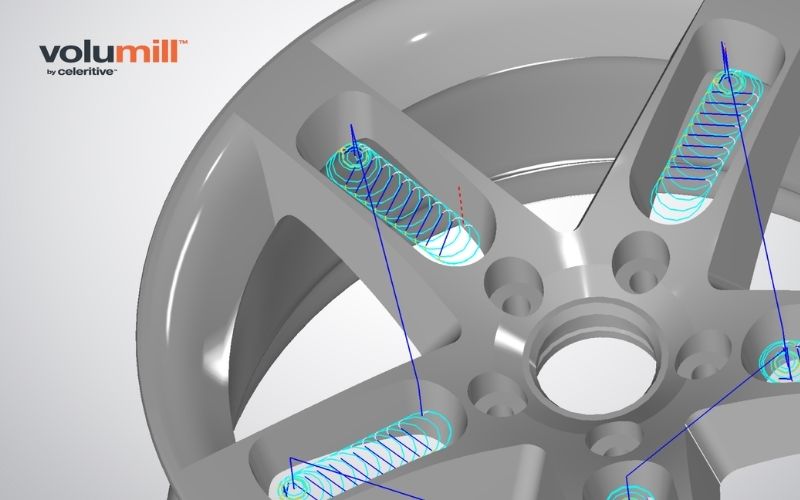
VoluMill for ZW3D solves this issue by calculating the Material Removal Rate (MRR) for every segment of the toolpath and continuously adjusting the toolpath geometry to keep the MRR within a user-defined limit. When a direction change is required, instead of making a sharp turn, the tool moves along tangent arc transitions to ensure that the material volume encountered per unit of tool travel does not exceed the programmed threshold.
In addition, VoluMill automatically adjusts the feedrate according to each machining region. In straight paths or areas with less material engagement, the tool moves faster; in heavy-cutting regions or tight-radius areas, the feedrate is reduced accordingly to maintain a stable tool load. This entire process is performed automatically without requiring manual intervention from the programmer.
2.2 Compatibility with All Geometry Types
One of the key strengths of VoluMill for ZW3D is its ability to operate effectively on virtually all machining geometries — including open areas, closed pockets, flat cavities, complex 3D surfaces, and parts with multiple material islands. This means users do not need to classify parts before selecting a machining strategy — VoluMill automatically recognizes the geometry and generates the most suitable toolpath.
This provides a significant practical advantage for machine shops handling a wide variety of products, where programmers may need to create toolpaths for completely different geometries every day.
2.3 Direct Integration into ZW3D CAM
VoluMill for ZW3D is not standalone software — it functions as an integrated module within ZW3D CAM, appearing as an additional machining strategy alongside existing CAM operations. All tooling data, stock material settings, machine parameters, and 3D models already defined in ZW3D can be used directly by VoluMill without re-importing or converting file formats.
This allows programmers to continue using their existing workflow without needing to relearn the entire programming process. VoluMill enhances the current workflow rather than replacing or disrupting it.
3. Practical Benefits of Implementing VoluMill for ZW3D
This section focuses on the real operational improvements that machine shops experience after implementing VoluMill for ZW3D.
3.1 Significantly Extended Tool Life
Thanks to consistent MRR control and the elimination of sudden load spikes, cutting tools are less exposed to localized thermal shock and uneven wear. Under suitable machining conditions — especially when working with difficult-to-cut materials such as alloy steel, titanium, or Inconel — tool life can increase by up to 800% compared to conventional machining strategies.
An 800% increase may sound substantial, but it is important to understand the context: this level is typically achieved under ideal conditions with difficult materials. In standard steel machining, real-world improvements are more commonly in the 200–400% range, which still represents a highly meaningful reduction in tooling cost per part.
3.2 Higher Machining Speed and Reduced Cycle Time
Because the cutting tool experiences less wear and lower cutting temperatures, users can increase cutting speeds and feedrates beyond conventional limits while still maintaining acceptable tool life. As a result, machining time per part decreases, and machine throughput increases without requiring additional equipment investment.
This creates a dual benefit: lower tooling costs and higher production capacity within the same operating time.
3.3 Better Protection for Machines and Spindles
Since cutting loads remain stable without sudden force spikes, machine vibration is significantly reduced. This not only improves surface finish quality but also extends the service life of the spindle, ball screws, and drivetrain components. In overall ROI calculations, this reduction in machine maintenance costs is often overlooked, yet it can represent substantial long-term savings.
3.4 Simplified Programming Without Special Workarounds
With conventional high-speed machining strategies, programmers often need to apply multiple manual techniques to avoid sudden load increases — such as manually adjusting feedrates at corners, dividing machining regions into smaller areas, or adding auxiliary tool movements. VoluMill for ZW3D automates all of this logic. Programmers only need to define the machining limits and parameters, while VoluMill automatically handles the remaining optimization process.
4. Comparison Between VoluMill for ZW3D and Conventional CAM Strategies
| Criteria | Conventional CAM Machining | VoluMill for ZW3D |
|---|---|---|
| MRR Control | Not available | Automatically controlled for every micro-segment |
| Toolpath Motion | Straight lines with sharp corners | Continuous tangent arc motion |
| Feedrate Adjustment | Manual or unavailable | Automatically adjusted based on actual cutting load |
| Tool Life | Standard level | Increased by 200%–800% depending on material |
| Cutting Temperature | Fluctuating, prone to sudden spikes | More stable and lower at the same cutting speed |
| Machine Vibration | Higher in direction-change areas | Significantly reduced due to smoother toolpaths |
| Geometry Compatibility | Depends on selected strategy | Works on all geometry types |
| Learning Curve | Long, highly experience-dependent | Short, usable from the first day |
5. What Types of Manufacturing Are Best Suited for VoluMill for ZW3D?
Not every machine shop will benefit from VoluMill for ZW3D to the same extent. The software delivers the greatest value in the following production environments:
Mold and Injection Mold Manufacturing: Mold and injection mold machining is one of the most typical applications. Mold components often contain deep cavities, tight internal corners, and demanding surface finish requirements. This is exactly the type of environment where VoluMill performs best — complex cavity regions are handled automatically with smooth toolpaths, significantly reducing rough machining time.
Machining Difficult-to-Cut Materials: Materials such as hardened alloy steel, titanium, Inconel, and stainless steel are where VoluMill demonstrates the clearest economic advantages. In these applications, tooling costs account for a significant portion of the product cost, so any improvement in tool life has a direct impact on profitability.
Mass Production: High-volume manufacturing is where the benefits of VoluMill multiply rapidly. When the same part is machined hundreds or thousands of times, reducing cycle time by even a few minutes or extending tool life several times over accumulates into substantial cost savings.
Aerospace, Medical Devices, and High-Precision Components: Industries such as aerospace, medical equipment manufacturing, and other precision engineering sectors also benefit greatly from reduced vibration and stable cutting forces — factors that directly influence dimensional accuracy and surface finish quality.
Cases with Lower ROI Potential: On the other hand, if your shop mainly machines simple parts made from soft materials with low production volumes, VoluMill can still provide benefits, but the return on investment period will generally be longer compared to the applications above.

6. Frequently Asked Questions About VoluMill for ZW3D
Does VoluMill for ZW3D Require a Specific ZW3D Version?
VoluMill is an officially supported add-on developed for integration with ZW3D CAM. To ensure compatibility, you should confirm your current ZW3D version with the distributor before purchasing a license. The technical team at SDE.vn can assist with compatibility verification and consultation free of charge.
I Am Already Using Other Machining Strategies in ZW3D. Do I Need to Replace Them When Using VoluMill?
No. VoluMill for ZW3D adds an additional machining strategy to the existing ZW3D CAM environment and does not replace your current workflows. You can use VoluMill for suitable operations while continuing to use your existing strategies for other machining tasks.
Does VoluMill Work Well with Aluminum and Copper?
Yes. Although VoluMill delivers the most significant economic advantages when machining difficult-to-cut materials, it also provides clear benefits for aluminum and copper machining, mainly through higher machining speeds and improved surface finish quality. In aluminum machining especially, VoluMill allows very high feedrates while maintaining stable tool motion and cutting conditions.
Is the VoluMill for ZW3D License Based on Machines or Users?
The specific licensing model depends on the software version and licensing agreement. Contact SDE.vn for detailed consultation on the licensing option that best fits your workshop size and production requirements.
VoluMill for ZW3D is a high-speed machining solution built on a scientifically proven engineering foundation, with precise MRR control throughout the entire toolpath. If your workshop is facing high tooling costs, long machining times for complex parts, or the need to increase productivity without investing in additional machinery, VoluMill for ZW3D is a solution worth serious consideration.
Contact SDE TECH for consultation and to schedule a demonstration.
- Website: sde.vn
- Email: sales@sde.vn
- Hotline/Zalo: 085 256 2615 – 0909 107 719