Tiếng Việt
 日本語
日本語 한국어
한국어
Integrating Digital Product Definition
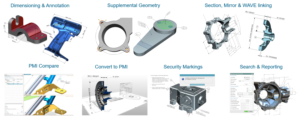
Product development is becoming increasingly complex. Cars are evolving into computers on wheels. Aircraft are shifting from mechanical systems to electronic systems, and consumer products are becoming more and more personalized for end users. Some of these challenges require enhanced software security, while others leverage innovative manufacturing techniques such as additive manufacturing.
Addressing this complexity requires deeper insight across the entire enterprise. For mechanical engineering, this is being driven by Digital Product Definition, commonly referred to as Model-Based Definition (MBD).
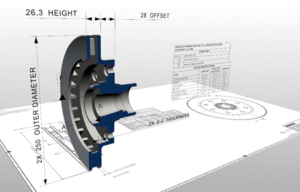
At its core, MBD uses the 3D solid model as the single source of truth for a project. For larger programs, this can be incorporated into a digital twin of the entire process, from concept to service. MBD includes geometric dimensioning and tolerancing (GD&T), surface finishes, detailed metadata, and supplemental geometry, all of which can be extracted using Product and Manufacturing Information (PMI).
Traditionally, this information was scattered across drawings in the form of notes, supplemental documents, or other hard-to-track formats. When working on safety-critical projects in aerospace or medical industries, traceability is essential for any design. However, MBD integration is not only a solution for safer development, but also for more efficient development.
PMI data can be extracted from the model for use in manufacturing, quality assurance, and sharing with suppliers—significantly reducing common errors while clearly communicating design intent. Simplified information handoff shortens time to market, improves accuracy and efficiency, and allows engineering teams to focus on value-added activities.
To learn more about how MBD is enhancing product development, revisit the webinar with Dave Wingrave – Siemens NX Software Division™, and Dr. Ken Versprille – CIMdata, discussing advancements in PMI.
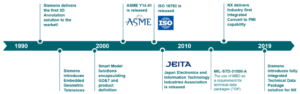
The use of PMI is not a new technique. In fact, NX PMI has been used for decades in the aerospace and automotive industries. However, as more companies adopt digital transformation, the benefits of PMI—and more broadly MBD—are becoming a reality. Artificial intelligence features introduced in the December 2020 NX release have made dimensioning significantly easier, requiring just a few clicks instead of hours of manual work.
Ease of use remains one of the final barriers to PMI and MBD adoption, as many organizations still perceive it as additional effort, with limited downstream processes consuming the information and legacy documentation remaining part of the development workflow.
As discussed in analyses of MBD and additive manufacturing (AM), hybrid technologies may drive entirely new manufacturing processes—if not a new generation of manufacturing. This is particularly relevant in discussions around hybrid printing for future machine shops, where storing all manufacturing information directly within the model enables machinists, and even machines themselves, to intelligently combine traditional and AM techniques.
MBD also supports purely AM-driven designs. Lattice structures for lightweighting or increased stiffness rely on relational geometry, which, while not impossible without MBD, are far more time-consuming to create—often requiring complex programming and manual modeling to generate the lattice networks.
Digital Product Definition is at the forefront of the digital transformation wave—where today meets tomorrow. MBD enables traceability throughout the development lifecycle, opens new opportunities for innovative design geometries, and communicates information more effectively than ever before. Siemens Digital Industries Software is driving this transformation to build the digital enterprise where mechanical design, manufacturing, and electronics converge in the future.
Source: Siemens
SDE Digital Technology Co., Ltd. (SDE TECH) was established in 2014. In 2018, we were honored to become a Smart Expert Partner – a leading partner of Siemens Digital Industries Software in the Southeast Asia – Asia Pacific region for Siemens NX (Unigraphics NX), Simcenter, Solid Edge, Tecnomatix, and Teamcenter lifecycle management solutions.  Enterprises and customers wishing to contact SDE TECH using the following information: