Tiếng Việt
 日本語
日本語 한국어
한국어
In the era of digital manufacturing, managing a product is no longer limited to design or machining alone. To ensure a product’s success, enterprises need a comprehensive data management system that spans the entire journey—from the initial idea to the product’s withdrawal from the market. That system is PLM. So, what is PLM, what benefits does it deliver, and which solutions will lead the market in 2026? Let’s explore these questions together with SDE Tech.
1. What is PLM?
PLM is the abbreviation of Product Lifecycle Management. It is a strategic approach to managing the entire journey of a product, encompassing all related data, people, processes, and business systems throughout its lifecycle.
In essence, PLM is not just a standalone software application. It acts as a digital backbone that connects different departments across an organization. From R&D (Research & Development), engineering design, and simulation to manufacturing, marketing, and after-sales service—all teams work on a single, consistent, and unified source of product data.
PLM is often confused with PDM (Product Data Management). However, while PDM focuses mainly on managing engineering files (such as CAD files), PLM has a much broader scope, covering the entire set of business processes surrounding a product from concept to end of life.
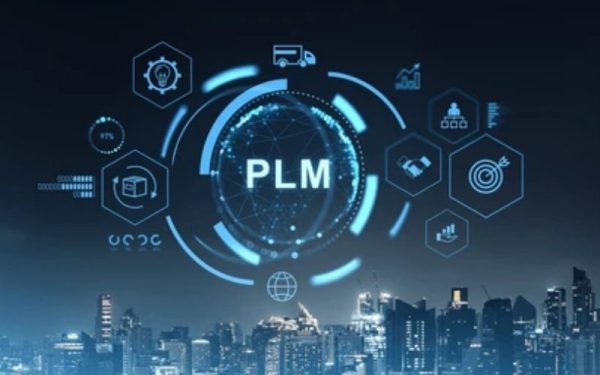
2. The Four Core Stages of the Product Lifecycle in a PLM System
A standard PLM system enables enterprises to tightly control the following four key stages:
- Concept & Design: This is where customer requirements are analyzed and transformed into 2D/3D CAD designs.
- Development & Simulation: CAE tools are used to perform virtual testing and optimize product performance before building physical prototypes.
- Manufacturing & Supply Chain: This stage covers manufacturing planning (CAM), Bill of Materials (BOM) management, and integration with component suppliers.
- Service & Disposal: Managing maintenance schedules, collecting feedback from end users, and handling recycling or product disposal processes at the end of the product lifecycle.

3. Why Manufacturing Enterprises Need a PLM System Today?
Implementing PLM delivers breakthrough benefits in both productivity and cost efficiency:
- Creating a “Single Source of Truth”: Eliminates the situation where each department maintains a different version of the same design. All changes are updated in real time across the entire system.
- Shortening Time-to-Market: Thanks to seamless cross-functional collaboration, product development cycles can be reduced by 20–40%.
- Reducing Error-Related Costs: Effective control of engineering changes (Engineering Change Orders – ECOs) helps companies avoid manufacturing based on outdated drawings, significantly minimizing material waste and rework.
- Enhancing Innovation Capability: When data is managed in a structured and systematic way, engineers can spend more time on product innovation instead of searching for legacy files and documents.

4. The Digital Thread Connection: CAD – CAE – CAM – PLM
Within the SDE Tech ecosystem, PLM serves as the central data hub. The concept of the Digital Thread is established when data flows seamlessly from design (CAD) to simulation (CAE), then to manufacturing programming (CAM), with all information fully tracked and governed by the PLM system. This ensures complete data continuity and traceability throughout the product lifecycle, enabling enterprises to quickly identify and trace the root cause of any issue that may arise at any stage of development, manufacturing, or operation.

See also: CAD CAM CAE PLM là gì?
5. Breakthrough PLM Technology Trends in 2026
Entering 2026, PLM technology is undergoing a strong transformation driven by several key trends:
- Cloud PLM (SaaS): Enables small and medium-sized enterprises (SMBs) to access enterprise-grade management systems with significantly lower infrastructure investment costs.
- AI Integration: Artificial intelligence supports supply chain risk forecasting and automates design approval and validation workflows.
- Digital Twin: Connects real-world operational data from product sensors back into the PLM system, enabling continuous improvement for next-generation products.
6. Top Leading PLM Software Solutions in 2026
To build a robust and future-proof PLM workflow, enterprises need powerful and flexible tools. Below are the leading solutions:
6.1 Teamcenter (Siemens) – The World’s No.1 PLM Solution
Teamcenter is the most comprehensive PLM software available today, trusted by global giants such as Boeing, Ford, and Samsung. Beyond design data management, Teamcenter connects the entire value chain—from requirements management and quality management to manufacturing operations management. Its outstanding scalability and enterprise-level security make Teamcenter the top choice for organizations aiming to build smart factories and achieve digital transformation.
6.2 3DViewStation (Kisters) – Ultra-fast 3D Visualization and Analysis Tool
In a PLM environment, not everyone needs or knows how to use complex CAD software. 3DViewStation is the ideal solution for departments such as Purchasing, Sales, and Production Management.
- Key advantages: Enables fast viewing, measurement, and analysis of extremely large 3D files (tens of thousands of components) within seconds—directly via a web browser or mobile device.
- Integration: 3DViewStation integrates seamlessly with Teamcenter, allowing everyone in the organization to interact with 3D data without installing heavy CAD applications.
6.3 Windchill (PTC) & ENOVIA (Dassault Systèmes)
These are two major competitors in the PLM market, particularly strong in product configuration management and user-experience-driven collaboration.
7. Criteria for Selecting the Right PLM Software for Your Enterprise
Investing in PLM is a long-term strategic decision. Enterprises should carefully evaluate the following factors:
- Compatibility: Does the PLM system provide strong support and integration with the CAD software currently in use (such as NX, Solid Edge, CATIA, etc.)?
- Flexibility: Can the software be customized to match the company’s specific approval workflows and business processes?
- Scalability: Can the system be easily expanded and upgraded as the organization grows in size and complexity?

8. SDE Tech – Your Trusted PLM Consulting and Implementation Partner
With extensive experience in delivering digital transformation projects in Vietnam, SDE Tech is proud to be a strategic consulting partner for PLM solutions and advanced supporting tools such as 3DViewStation.
Our engineering team not only has deep expertise in software solutions but also possesses strong hands-on knowledge of manufacturing management. This enables us to help enterprises build a clear, phased PLM implementation roadmap—from simple to advanced—ensuring fast deployment, measurable business value, and sustainable economic efficiency.
9. Frequently Asked Questions about PLM
9.1 How is PLM different from ERP?
ERP (Enterprise Resource Planning) manages the “how much” — finances, human resources, and inventory. PLM, on the other hand, manages the “what” — product designs, engineering data, and product-related information. These two systems are complementary and should be integrated to achieve end-to-end enterprise optimization.
9.2 Should small businesses invest in PLM?
Yes. Today’s Cloud PLM solutions offer flexible pricing models, enabling small and medium-sized enterprises to build a professional data management foundation from the very beginning—avoiding costly errors and rework as the business scales.
9.3 Can 3DViewStation replace CAD software?
No. 3DViewStation is a tool for viewing, analyzing, and collaborating on 3D data. It does not provide design authoring capabilities like NX or Solid Edge. However, it makes 3D data far more accessible and usable for non-engineering departments such as purchasing, sales, and management.
Understanding what PLM is and implementing it correctly is the golden key for enterprises to truly take control of their products in the digital era. The combination of Teamcenter’s powerful product lifecycle management capabilities and the flexibility of 3DViewStation creates a solid launchpad for sustainable business growth. Contact SDE Tech today to receive professional consultation and an in-depth PLM solution demo!
- Email: sales@sde.vn
- Hotline/Zalo: 085 256 2615 – 0909 107 719