Tiếng Việt
 日本語
日本語 한국어
한국어
MODEL-BASED VALIDATION AND CONTROL UNIT DESIGN OPTIMIZATION WITH SIMCENTER

In 1968, Volkswagen became the first company to use a computer in a car. The D-Jetronic, created by Bosch, controlled the fuel injection system in Volkswagen’s Type-3 models.
By 2009, premium and luxury vehicles contained more than 100 million lines of code.
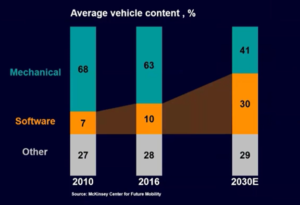
Today, even the most basic vehicles contain millions of lines of code. According to the McKinsey Center for Future Mobility, software will account for nearly 30% of a vehicle’s total architecture by 2030.
“Software used to be a part of the car. Now, software determines the value of a car.”
–Manfred Broy, Honorary Professor of Computer Science, Technical University of Munich–
Two factors driving this transformation? Can you guess? Electric vehicles and autonomous vehicles?
Electric Vehicles
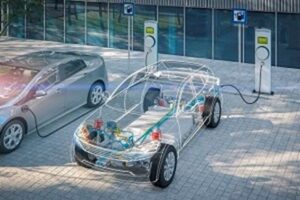
Electric vehicles (EVs) introduce new software complexities and requirements. Software must balance emissions, vehicle performance, battery range, and multiple motors for AWD vehicles.

Autonomous Vehicles
Autonomous vehicles and vehicles with driver assistance features also require more complex software. The biggest challenge for ADAS engineers is the sheer number of scenarios needed to validate software functionality. Coupled with the fact that, due to legal and safety responsibilities, these scenarios cannot be reasonably tested in physical environments.
Several high-profile cases have shown autonomous features not working as intended. Users reported accidents and injuries due to automatic emergency braking (AEB) triggering “phantom braking” on roads. Lane Keeping Systems (LKS) have experienced similar issues. The American Automobile Association identified the most common assisted driving issues as:
- Sudden disengagement (sometimes in critical situations)
- Non-functioning
- Error corrections
- “Ping-ponging” on the road
- Uncomfortably close following distance
- Lane crossing: curves, transitions, slopes, steep roads
Clearly, change is needed.
Control Unit Calibration as a Solution
First, let’s define calibration. At Simcenter Engineering Services, calibration is the act of adjusting parameter values, functions, and/or tables in a control unit to achieve the desired overall system behavior.
Until recently, calibration was only performed on physical prototypes. However, this approach is no longer a viable option.
Thanks to model-based development (MBD) and virtual validation, automotive engineers can now pre-load and automatically calibrate control units. This method is safer, more cost-effective, and more efficient than traditional road testing and calibration.
Accelerating Control Unit Calibration with System Simulation
Ammon Wright from Simcenter Engineering Services recently presented a webinar demonstrating how MBD and virtual validation help companies to:
- Use system simulation to validate MiL, SiL, HiL, ViL, and control
- Understand requirement differences between validation models and control unit calibration
- Address gaps between virtual calibration challenges and real calibration
- Pre-load control unit calibration at different development stages
- Deploy optimization tools to find the best calibration parameters
Source: Siemens
SDE TECHNOLOGY CO., LTD (SDE TECH) was established in 2014. By 2018, we became a Smart Expert Partner – a leading partner of Siemens Digital Industries Software in Southeast Asia – Pacific region for Siemens NX (Unigraphics NX), Simcenter, Solid Edge, Tecnomatix, and Teamcenter solutions.