Tiếng Việt
 日本語
日本語 한국어
한국어
In the era of electric vehicles (EVs) and autonomous driving, optimizing performance and safety has become a top priority for OEMs. CFD simulation in the automotive industry plays a critical role by enabling accurate prediction of complex flow phenomena while supporting the realization of innovative design concepts that traditional testing methods often cannot accommodate in a timely manner.
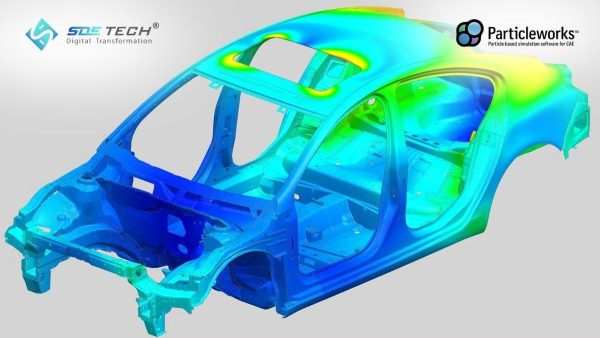
1. Overview of CFD Simulation in Automotive Engineering
Computational Fluid Dynamics (CFD) is a numerical method that uses algorithms and mathematical models to simulate the behavior of fluids and gases. In the automotive industry, CFD is widely used to analyze the interaction between airflow and vehicle bodies, water and underbody structures, as well as the movement of fuel and lubricating oil within mechanical systems.
CFD is particularly valuable because it can provide highly accurate data on pressure, velocity, and temperature at locations that are difficult or impossible to measure in real-world experiments. This capability enables engineers to make more informed decisions and optimize designs more effectively.
1.1. The Shift from Physical Testing to Digital Simulation (Digital Twin)
In the past, evaluating aerodynamic performance required automakers to test physical models in wind tunnels or conduct extensive road testing—both of which involved extremely high costs.
Today, the Digital Twin approach is increasingly replacing traditional testing methods. By creating a comprehensive digital replica of a vehicle, engineers can run thousands of simulation scenarios in a virtual environment. This allows potential design issues to be identified during the concept stage, reducing the risk of costly mold or tooling changes during mass production—one of the most significant sources of financial loss in vehicle manufacturing.
1.2. Benefits of CFD: Reducing Wind Tunnel Costs and Accelerating R&D
Operating a standard wind tunnel facility can cost thousands of dollars per testing hour. In contrast, adopting CFD simulation in the automotive industry allows companies to achieve several strategic advantages:
- Minimize the number of physical prototypes: Only designs that have passed virtual validation are moved forward to real-world production.
- Shorten the product development cycle (R&D): Simulations can run in parallel and continuously 24/7 on high-performance computing systems, helping companies bring products to market faster than competitors.
- Enable multi-objective optimization: CFD allows engineers to simultaneously optimize aerodynamic performance and thermal management, something that is extremely difficult to achieve through physical testing alone.
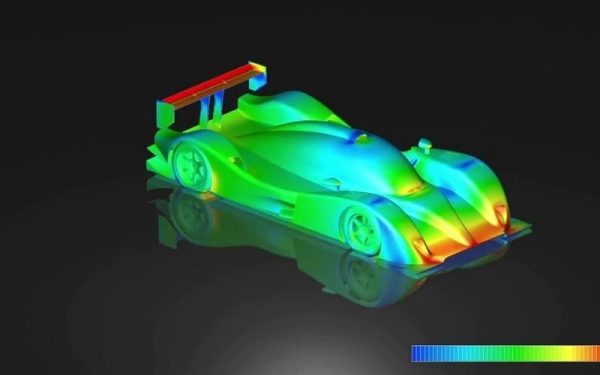
2. Core Applications of CFD Simulation in Automotive Vehicles
The applications of CFD simulation cover nearly every component of a modern vehicle, from exterior aerodynamic surfaces to complex internal systems.
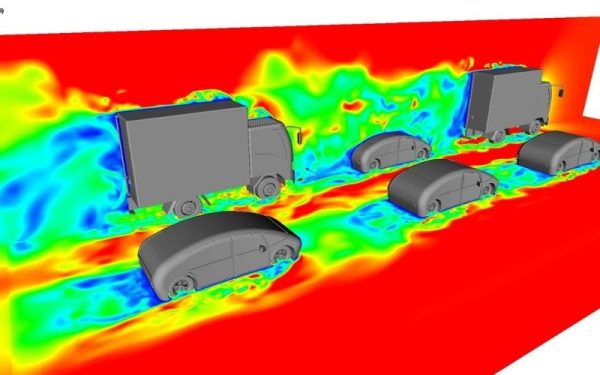
Exterior Aerodynamic Optimization (Drag Coefficient – Cd): CFD analyzes the pressure zones at the front of the vehicle, the wake region at the rear, and the airflow beneath the underbody. This enables engineers to optimize the design of mirrors, air intakes, and spoilers in order to reduce drag and improve overall vehicle efficiency.
Engine Thermal Management: CFD simulates airflow through the radiator system and evaluates heat distribution within the engine compartment. This helps protect heat-sensitive components such as the ECU and battery systems from overheating, thereby improving reliability and durability.
Cabin HVAC System Simulation: CFD evaluates airflow distribution from air vents, heat radiation from glass surfaces, and heat generated by passengers. This analysis helps optimize thermal comfort inside the cabin while maintaining energy efficiency.
Aeroacoustic Analysis: CFD can simulate unsteady airflow behavior to identify sources of aerodynamic noise around areas such as the A-pillar, side mirrors, and door gaps. These insights enable engineers to refine the design to reduce wind noise when the vehicle operates at high speeds.
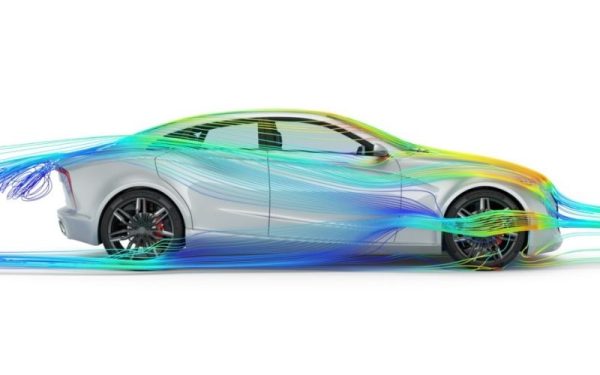
3. Simulation of Wading and Splash Phenomena Using Meshless Methods
This is a highly specialized and challenging area within CFD simulation in the automotive industry, where traditional mesh-based methods often face significant limitations.
3.1. Vehicle Wading Analysis and Flow Impact on the Underbody
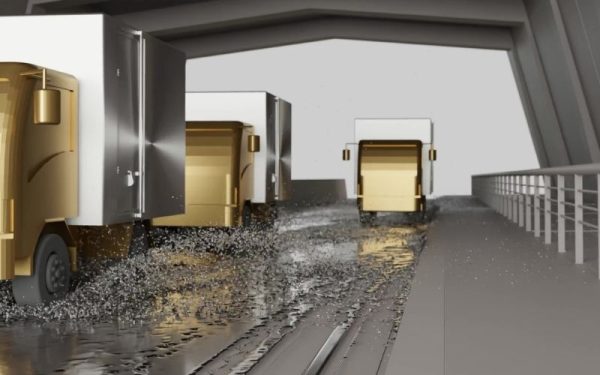
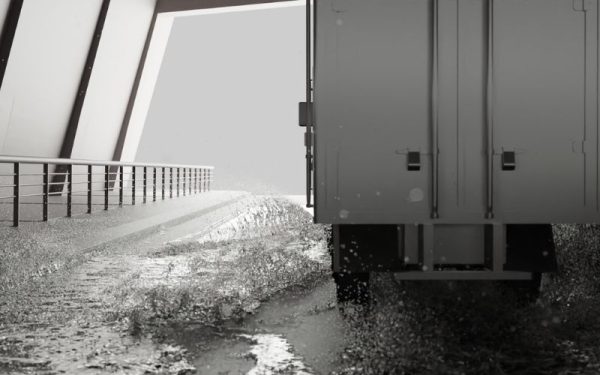
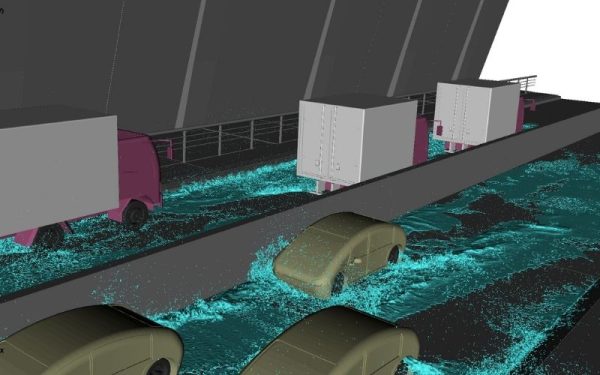
When a vehicle passes through flooded areas, water can potentially enter the air intake system or damage sensitive underbody sensors. Simulating vehicle wading requires modeling complex interactions between liquid and gas phases.
Meshless simulation methods enable accurate tracking of water levels and wave forces acting on the vehicle underbody, allowing engineers to better evaluate and optimize the design of underbody shields and protective structures.
3.2. Simulation of Mud and Rain Splash on Windshields and Sensors (Soiling)
The soiling phenomenon occurs when mud, water droplets, or road debris splash onto the windshield or vehicle sensors, potentially obstructing advanced driver-assistance systems (ADAS) such as radar and LiDAR. Advanced CFD simulation techniques, particularly particle-based approaches, allow engineers to predict the trajectory and deposition patterns of water droplets and dirt particles under adverse driving conditions. These insights help optimize sensor placement and vehicle design, reducing signal interference and enhancing overall driving safety.
4. Verifying Safety and Performance of Powertrain Systems
The strength of CFD simulation extends beyond the vehicle body and into the core mechanical systems that drive vehicle performance.
4.1. Simulation of Lubrication and Cooling Oil Flow Inside the Gearbox
Uneven distribution of lubricating oil within a gearbox can lead to gear overheating, gear tooth damage, or excessive energy losses caused by oil churning resistance. CFD enables engineers to visualize how lubricating oil is splashed and distributed across gear components at different rotational speeds, ensuring that all friction surfaces receive sufficient lubrication while heat generated during operation is effectively dissipated.
4.2. Pressure Distribution and Flow Analysis in Intake and Exhaust Systems
Engine performance is heavily influenced by the efficiency of the intake and exhaust systems. CFD allows engineers to optimize the geometry of intake manifolds to improve airflow swirl and mixing within the combustion chamber. At the same time, it helps reduce back pressure in the exhaust system, which can enhance engine power output and contribute to lower emissions.
4.3. Brake Thermal Management and Cooling Optimization
During repeated heavy braking, brake disc temperatures can reach several hundred degrees Celsius, potentially leading to brake fade, where braking performance significantly decreases. CFD simulation in the automotive industry supports the design of ventilation grooves on brake discs and airflow ducts that channel air from the front bumper to the braking system, ensuring effective heat dissipation and maintaining optimal braking safety.
5. Leading CFD Software Ecosystem
SDE Tech serves as a strategic partner delivering advanced simulation solutions from some of the world’s leading software developers.
5.1. Simcenter STAR-CCM+: A Comprehensive Multiphysics Simulation Solution
Simcenter STAR-CCM+ is one of the leading platforms for CFD simulation in the automotive industry. Its key strength lies in its ability to integrate multiphysics simulations within a single environment, including aerodynamics, heat transfer, and aeroacoustics. This unified simulation workflow enables engineers to analyze complex physical interactions more efficiently while reducing the need to switch between multiple software tools.
5.2. Particleworks: Advanced Meshless Fluid Simulation for Complex Problems
For scenarios involving free-surface fluid motion, such as gearbox oil churning or vehicle wading, Particleworks provides a powerful and specialized solution. Using the MPS (Moving Particle Simulation) method, the software can accurately simulate fluid–structure interactions with high stability and visualization clarity—areas where traditional mesh-based CFD solvers often struggle with convergence issues.
5.3. Integration of CFD Simulation with Virtual Driving Environments from VI-grade
Beyond static CFD analysis, simulation results can be integrated into driving simulators developed by VI-grade. This integration allows test drivers to experience the effects of aerodynamic forces or flooded road conditions within a realistic virtual environment. Such capabilities represent one of the most advanced approaches currently available for vehicle design validation and performance evaluation.
6. Criteria for Selecting the Right CFD Simulation Solution for Enterprises
Investing in a CFD simulation system requires careful evaluation of both technical capabilities and economic considerations.
6.1. CAD Data Compatibility and Solver Performance
A robust CFD solution should be able to directly import and process complex CAD data from leading design platforms such as Siemens NX, CATIA, or Solid Edge without compromising model integrity. Equally important is the solver performance. The solver must be optimized to fully leverage available hardware resources, enabling fast computation times while maintaining high simulation accuracy.
6.2. Hardware Infrastructure Requirements (HPC / Cloud Computing)
Automotive CFD simulations often involve millions or even billions of mesh cells or particles, making high computational power essential. As a result, companies typically need to deploy High Performance Computing (HPC) systems or adopt flexible cloud computing solutions to run simulations efficiently. SDE Tech also provides consulting services to help organizations determine the optimal hardware configuration, ensuring that the simulation software operates at maximum performance and efficiency.
7. Frequently Asked Questions About CFD Simulation in the Automotive Industry
7.1. How accurate are CFD simulation results compared to real-world experiments?
Today, thanks to advanced turbulence models and powerful computing capabilities, the deviation between CFD simulation results and wind tunnel experiments is typically only around 1–3%. In many cases, simulation results can serve as a reliable technical basis for design validation and engineering decision-making.
7.2. When should companies invest in meshless simulation?
If a company frequently deals with problems involving fluid splashing, gearbox lubrication, or complex moving mechanisms where mesh-based methods require excessive preprocessing time, it is the right time to consider adopting Particleworks. Meshless particle-based simulation can significantly simplify model preparation and improve simulation stability for complex fluid–structure interaction problems.
7.3. What is the cost of implementing an advanced CFD system?
The cost depends on several factors, including project scale, number of users, and simulation complexity. However, compared with the risks associated with product design flaws or the high cost of wind tunnel testing, investing in CFD simulation for the automotive industry often delivers a high return on investment (ROI) after only a few projects.
Today, CFD simulation in the automotive industry is no longer a luxury but has become a critical requirement for companies aiming to remain competitive and achieve sustainable growth. Effectively leveraging advanced tools such as Simcenter STAR-CCM+ and Particleworks will help Vietnamese automotive manufacturers enhance their engineering capabilities and strengthen their position in the global market.
SDE Tech is committed to providing optimized simulation solutions and supporting customers throughout the entire process—from consulting and training to deployment and operational implementation. Contact SDE Tech today to begin your digital transformation journey and elevate the quality and performance of your products.
SDE Tech Contact Information:
- Website: sde.vn
- Email: sales@sde.vn
- Hotline/Zalo: 085 256 2615 – 0909 107 719
Related Article: Optimizing EV Lubrication and Thermal Management Systems with Particleworks