Tiếng Việt
 日本語
日本語 한국어
한국어
RAISING SAFETY STANDARDS IN THE OIL & GAS INDUSTRY WITH SIMULATION
How does simulation support safety standards and procedures in the oil & gas industry?
Discover some safety initiatives enabled by advanced engineering simulation and digital twins.

Is an offshore oil rig a dangerous workplace? Absolutely. Exposure to the elements, handling heavy and complex machinery, and dealing with flammable hydrocarbons mean that workers on rigs cannot take their tasks lightly.
Deploying an oil rig, a refinery, or transportation sites are all environments prone to accidents.
Falls, spills, collisions, burns… How can companies in the industry reduce safety incidents to zero?
In this article, we share some real insights on oil & gas safety and explore initiatives that can help reduce industry risk.
Health and safety performance better than expected
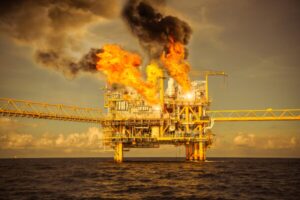
We’ve all seen images of tragic accidents. Oil wells on fire, rigs collapsing into the sea. Scenes straight out of a Hollywood blockbuster. But these are not the realities we want to face. Such accidents should belong to the past or only exist in the imagination of fiction writers. Oil companies must aim for zero-incident reports.
Fortunately, results are better than we feared.
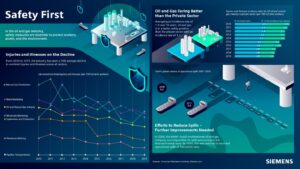
According to the 2019 annual report from the UK Oil & Gas Company, from 1996–2007, there were 21 fatalities in the UK oil sector. However, from 2007–2018, this number dropped to only 5. Additionally, according to the 2019 safety report from the International Association of Oil & Gas Producers, global fatalities in the sector decreased from 30 in 2017 to 27 in 2018. (Source: OHS Online)
Looking at the chart below, we see a positive trend in the U.S., particularly in the reduction of non-fatal incidents.
Three objectives of oil & gas safety standards and procedures
Why must companies in the oil & gas industry care about safety?
Safety is critical for three main reasons:
- First, safety measures protect workers. As noted, employees operate in hazardous environments. Safety measures preserve life and reduce the risk of non-fatal incidents. Companies should also not ignore indirect consequences in challenging workplaces, such as stress-related cardiovascular diseases.
- Second, they protect assets. Oil & gas is a capital-intensive industry. Protecting existing assets and ensuring safe operation under both normal and extreme conditions is crucial to avoid profit loss and maintain longevity.
- Finally, they protect the environment. More than ever, corporate governance policies must address ecological concerns. Oil spills are not rare. Appropriate measures prevent fires, leaks, or gas emissions that endanger workers’ health and harm the environment. Proper policies also help mitigate damage if incidents occur.
So, what’s the key to achieving zero incidents? Safety measures, accident prevention, and advanced technology are all essential.
Role of safety standards and procedures in the oil & gas industry
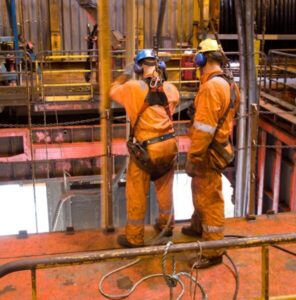
Lower incident reports result from learning from mistakes, establishing safety boards, and exploring preventive measures. For example, the American Petroleum Institute has actively contributed to safety improvement by setting industry-wide standards. Many preventive and safety measures have been adopted in the oil & gas sector.
Specific measures include:
- Clean, organized work environments
- Clear signage
- Proper personal protective equipment (helmets, gloves, etc.)
- Well-maintained machinery
- Use of advanced safety-enhancing technologies
Regarding the last point, advanced safety technologies are diverse and include:
- Using drones or robots to minimize human exposure to hazards from machinery or equipment
- Automation techniques to perform repetitive or tedious tasks
- Simulation technology to predict and prevent harmful incidents
- Digital twins for predictive maintenance
Other intangible safety measures include:
- Proper and regular training
- Clear and thorough procedures
- Regularly updating procedures to match real work environments
- Attention to physical and mental health of employees
- Efforts to build a strong safety culture
Building a safety culture is essential for modern oil companies. Yet, safety measures do not always have a positive impact. Companies may see them as burdensome, restrictive, or ineffective.
At Simcenter, we believe simulation and digital twins are part of the solution. These technologies help companies implement safety procedures effectively and execute preventive and corrective measures.
How to simulate and use digital twins
Simulation and digital twin technologies mentioned earlier in this article are like advanced safety technologies. We further develop these technologies to demonstrate why they are effective in improving oil & gas safety.
Ensuring process safety
Process safety is vital for all oil & gas production and processing facilities. Using digital twins, safety-related scenarios can be simulated. The results and associated data can then be used to design and operate assets with maximum insight to reduce process safety risks.
Simcenter provides a range of solutions to simulate unique system and process states.
These solutions offer opportunities to:
- Create digital twins to visualize and understand real-world conditions
- Assess layout impact on incidents and safety-related consequences
- Simulate real-world states involving flow, heat transfer, structural response, and control systems
- Model unplanned scenarios, such as gas emissions and dispersion
- Manage interactions between production facilities and the environment
- Apply design space exploration to identify new ways to enhance process safety
- Manage all simulation and analysis data in one place
Risk reduction through scenario prediction
When incidents occur, simulation can help mitigate associated risks. Examples and case studies illustrate this concept.
Effective oil blowout control
Wild Well Control is a world-leading provider of emergency response services, pressure control, well relief planning, engineering, and training in the oil & gas sector. The company relies on modern simulation techniques to make well-informed control decisions, conduct response operations, prevent future incidents, and reduce risks. Applications include:
- Well control engineering (e.g., blowout rate, kick tolerance, dynamic kill simulation)
- Gas dispersion and subsea plume modeling to predict hydrocarbon behavior in blowout scenarios
- Thermal radiation modeling of flames
- Erosion modeling
- Thermal and structural analysis
Source: Siemens
SDE Digital Technology Co., Ltd. (SDE TECH) was established in 2014. By 2018, we became a Smart Expert Partner – a leading partner of Siemens Digital Industries Software in the Southeast Asia – Pacific region for Siemens NX (Unigraphics NX), Simcenter, Solid Edge, Tecnomatix, and Teamcenter management solutions.
 Businesses and customers may contact SDE TECH at the following: