Tiếng Việt
 日本語
日本語 한국어
한국어
3D Printing Automation
Additive Manufacturing (AM), also known as 3D printing, is an emerging technique for industrial production, but with its growth comes complexity.
Using the right tools removes much of the obstacles to a successful AM program, and automating some processes helps products reach the market faster while providing more design freedom during the concept development stage.
There are many ways to automate and optimize the design process depending on the application. Here are some approaches from Aaron Frankel’s “Advanced Additive” series.
Multi-Objective Optimization
For many, structural optimization involves finding the best-performing alternative for a pre-designed component, where key mounting points and geometries are labeled, and software starts removing unnecessary shapes. Beyond this, multi-objective optimization can be used to expand the design space at the beginning of product development.
Previously, simulation processes were separate from the designers’ and engineers’ experiential development, limiting the ability to truly provide the best components for the product.
Algorithmic Modeling
Complex structures generated by AM technology are often fascinating, but producing these shapes can be limited by tedious design processes. Drag-and-drop algorithmic models can be easily reused and adjusted, replacing the need to write code for geometric patterns and manually model them. These geometries can include lattice structures, meshing techniques, and even surface-based patterns for stiffness.
Strength Simulation
Each AM-produced component may vary in porosity and local microstructures. Minimizing these defects is not fully understood. With the right software tools, component strength can be assessed without destructive testing. A lightweight part is only better if it can withstand the intended operating environment. Machine learning is increasingly used to identify potential problem areas during these simulations.
Implicit Modeling
Structural link optimization is a great way to find new solutions, but what if the geometry is already defined? Implicit modeling allows the use of equation-driven geometries, even for structures impossible with traditional modeling techniques. This could include support-free printing structures or geometries optimized for fluid heat transfer. Using known functions reduces time and resources in simulations while delivering accurate results.
Natural Lattices
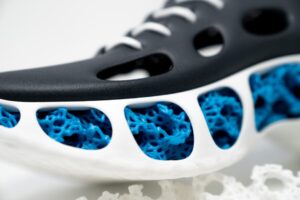
Lattice structures are a key optimization tool in additive manufacturing. They improve performance by reducing the overall weight of a part, removing unnecessary solid material, and even generating specific deformation features that mimic natural structures.
This allows designers to create ultra-lightweight shoes for athletes. Updates in design techniques now expand the number of usable lattice structures and the degree to which they can be customized.
Source: Siemens
SDE Technology Co., Ltd. (SDE TECH) was founded in 2014. By 2018, we proudly became a Smart Expert Partner – a leading Siemens Digital Industries Software partner in the ASEAN – Pacific region for Siemens NX (Unigraphics NX), Simcenter, Solid Edge, Tecnomatix, and Teamcenter management solutions.
 For businesses and customers, please contact SDE TECH via: