Tiếng Việt
 日本語
日本語 한국어
한국어
In the era of Industry 4.0, enhancing the competitiveness of manufacturing enterprises is no longer determined solely by production scale, but also by the ability to master technology during the pre-production stage. One of the key factors enabling leading corporations to optimize operational efficiency and product quality is the application of advanced CAE simulation methods. This technology is no longer just a supporting tool — it has become an essential standard in modern R&D processes.

1. What is CAE Simulation? Its Role in the Industry 4.0 Era
To fully understand the value of this technology, it is essential to accurately define CAE simulation methods (Computer-Aided Engineering). CAE refers to the use of computer software to simulate and analyze the physical conditions affecting a product design, enabling engineers to evaluate feasibility, structural integrity, and product performance before actual manufacturing takes place.
Many people often confuse CAD, CAM, and CAE, although each technology serves a completely different function within the manufacturing value chain:
- CAD (Computer-Aided Design): Focuses on creating 3D geometric models and technical drawings.
- CAM (Computer-Aided Manufacturing): Focuses on programming and controlling manufacturing equipment, such as CNC machines, to produce physical components.
- CAE (Computer-Aided Engineering): Focuses on “virtual testing.” While CAD defines how a product looks, CAE predicts how the product behaves under external conditions such as temperature, pressure, impact, vibration, or fluid flow.
In the era of Industry 4.0, CAE plays a critical role in the design optimization process. The ability to integrate digital data with highly accurate simulations enables businesses to build Digital Twin models, allowing them to predict product behavior throughout its entire lifecycle. This creates a major breakthrough in accelerating time-to-market while ensuring the sustainability and long-term efficiency of industrial manufacturing systems.
2. The Most Popular CAE Simulation Methods Today
Depending on the product characteristics and engineering challenges that businesses need to solve, CAE simulation methods are divided into multiple specialized disciplines. Selecting the right method not only improves simulation accuracy but also optimizes computational resources.
2.1. Finite Element Analysis (FEA)
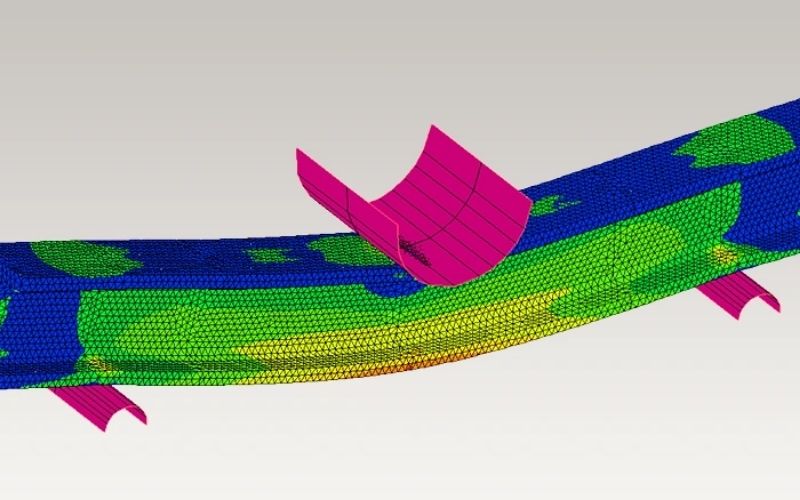
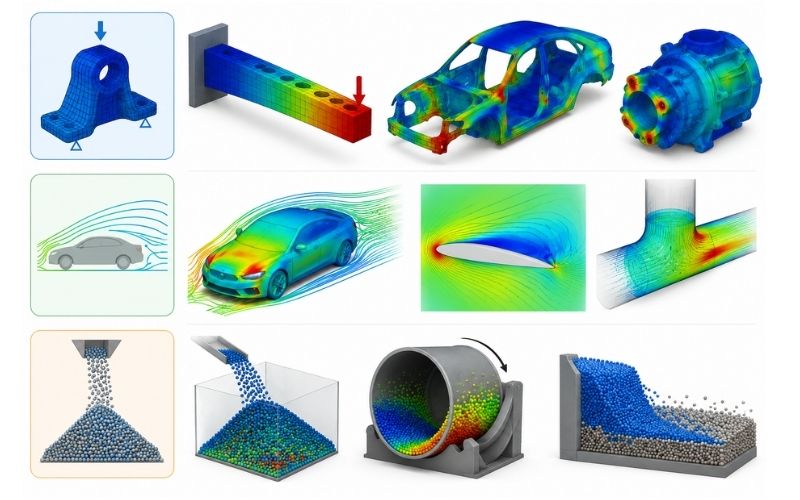
Finite Element Analysis (FEA) is one of the oldest and most widely used methods in the CAE ecosystem. The principle of FEA is to divide a complex structure into millions of smaller elements (mesh) in order to calculate physical responses with high precision.
In the mechanical and electronics industries, FEA is used to:
- Analyze stress and deformation of components under static or dynamic loads.
- Evaluate material fatigue after millions of operating cycles.
- Simulate impacts and analyze vibration behavior to ensure structural durability. The application of FEA helps engineers eliminate risks related to cracking or excessive deformation, which is especially critical in aerospace, automotive, and consumer electronics manufacturing industries.
2.2. Computational Fluid Dynamics (CFD) – Flow and Thermal Analysis
If businesses are facing challenges related to thermal management in electronic circuit boards, vehicle aerodynamics, or fluid flow inside piping systems, Computational Fluid Dynamics (CFD) becomes an indispensable engineering tool.
CFD utilizes numerical algorithms to solve equations related to the movement of liquids and gases. This CAE simulation method enables businesses to:
- Optimize air-cooling and liquid-cooling systems for data centers and high-power electronic devices.
- Analyze heat transfer between components to prevent overheating and equipment failure.
- Study Fluid-Structure Interaction (FSI), an extremely complex engineering challenge in turbine and pump design.
2.3. Particle Simulation (MPS/DEM) – Solutions for Fluids and Granular Materials
One of the latest advancements in CAE simulation methods that SDE TECH is pioneering is particle-based simulation technology. Unlike traditional CFD methods that require complex mesh generation, particle methods such as Moving Particle Simulation (MPS) and the Discrete Element Method (DEM) make it easier to simulate free-surface phenomena with high accuracy.
- MPS: Highly effective for simulating lubricating oil behavior inside gearboxes, liquid splashing during cooling processes, or industrial component washing applications. Particleworks is a leading software solution based on this technology.
- DEM: Specifically designed for granular materials such as powders, plastic pellets, and mixing or conveying processes in the pharmaceutical and food industries. The key advantage of this method is its ability to rapidly build simulation models and accurately reproduce phenomena that are difficult to achieve using conventional methods. Granuleworks is a software platform utilizing this technology.
3. Strategic Benefits of Applying CAE Simulation Methods in Manufacturing Businesses
Investing in CAE simulation methods is not simply a software expense — it is a strategic investment that delivers a high return on investment (ROI) by optimizing the entire product development and manufacturing process.
- Eliminating the Traditional “Trial-and-Error” Approach: In the past, engineers often had to manufacture physical products, conduct testing, redesign failed components, and repeat the process multiple times before achieving an acceptable result. This traditional “trial-and-error” approach was both time-consuming and extremely costly. With CAE simulation methods, businesses can perform thousands of virtual testing scenarios within just a few hours, enabling engineers to identify the optimal design solution from the earliest development stages.
- Minimizing Prototype Manufacturing Costs: Every physical prototype requires significant expenses in materials, labor, and machine operation. For components involving mold manufacturing, prototype costs can reach extremely high levels. By applying CAE simulation methods, companies can reduce the number of physical prototypes by 50–80%, using only the final prototype for validation purposes. This significantly lowers development costs while accelerating the overall product launch timeline.
- Accurately Predicting Potential Failures Before Mass Production: One of the greatest risks for manufacturers is discovering technical defects only after products have entered mass production and reached the market. Such issues can lead to product recalls, compensation costs, and severe damage to brand reputation. CAE acts as a virtual safety filter, helping businesses predict potential problems related to thermal behavior, structural durability, vibration, or functional performance before manufacturing begins. This ensures higher product quality, greater reliability, and improved customer satisfaction.
4. Frequently Asked Questions About CAE Simulation Methods
How accurate are CAE simulation results compared to real-world testing?
The accuracy of CAE simulation methods depends heavily on three key factors: mesh quality, the accuracy of boundary conditions (loads and constraints), and the precision of input material properties. When these parameters are properly configured by experienced engineers, simulation accuracy can typically achieve more than 90–95% correlation with real-world testing results.
Should small and medium-sized businesses invest in CAE solutions?
Yes. Although the initial investment in CAE software and engineering workstations may appear significant, it is still far lower than the potential losses caused by mass production defects or repeated mold redesigns. CAE enables small and medium-sized businesses to shorten the technology gap, improve product quality, and increase competitiveness when collaborating with large FDI manufacturers and global supply chains.
What support does SDE TECH provide for businesses that are new to CAE?
SDE TECH provides comprehensive support ranging from requirement analysis and software module consulting to direct technical training and 24/7 engineering support throughout the implementation process. In addition, we also offer CAE consulting and simulation services for short-term customer projects that require specialized engineering expertise.
Mastering CAE simulation methods is no longer optional — it has become an essential requirement for manufacturers aiming to survive and grow in the digital era. By optimizing product design, minimizing prototype costs, and predicting potential failures early, CAE delivers sustainable and measurable business value.
As a trusted technology partner, SDE TECH is committed to delivering advanced CAE solutions that help Vietnamese manufacturers strengthen their competitiveness in the global industrial landscape.
If your business is looking for a solution to optimize design and manufacturing processes, contact the experts at SDE Tech today for consultation and a live solution demonstration.
- Website: sde.vn
- Email: sales@sde.vn
- Hotline/Zalo: 085 256 2615 – 0909 107 719