Tiếng Việt
 日本語
日本語 한국어
한국어
In the context of the rapid growth of electric vehicles (EVs), cooling high-power electric motors has become a highly challenging thermal engineering problem. Unlike traditional CFD methods, which suffer from inherent limitations, particle-based CFD technology from Particleworks emerges as a breakthrough solution, enabling highly accurate simulation of complex multiphase flows to optimize motor performance and extend service life.
1. Overcoming the limitations of traditional methods
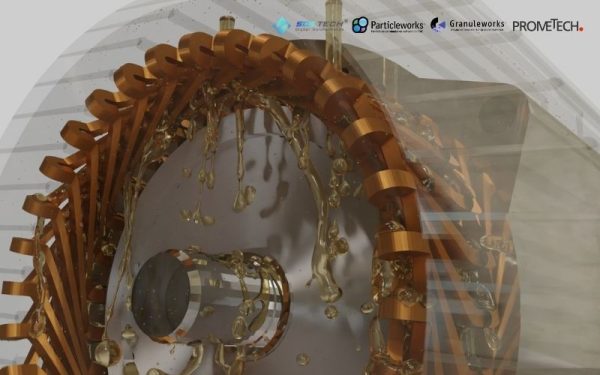
For oil-cooled electric motor systems, the cooling mechanism typically involves oil being supplied through a central shaft and then sprayed outward via strategically positioned injection holes, targeting the stator windings and critical boundary regions. This creates an extremely complex physical environment characterized by highly turbulent interactions between liquid oil, air, and fast-moving mechanical components.
Conventional CFD tools often require significant time for mesh generation and surface preparation, while also consuming enormous computational resources when simulating fluid splashing and free-surface behavior. In contrast, the MPS (Moving Particle Semi-implicit) method used by Particleworks is completely mesh-free, enabling much more efficient simulation of these multiphase interactions. As a result, it significantly reduces computational cost and shortens product development cycles.
2. Flow simulation and analysis workflow
To optimize electric motor cooling performance, engineers applied an innovative workflow that fully leverages the power of Particleworks at each simulation stage.
2.1 Quantifying flow distribution ratios
The first step in the workflow is to accurately determine how much oil reaches each cooling region. An internal flow simulation was performed to map the flow split among three groups of injection holes. The results showed distribution ratios of 47%, 34%, and 19%, respectively. Having these input parameters clearly defined is a crucial prerequisite for evaluating whether the current design delivers sufficient oil flow to critical hotspots within the motor.
2.2 High-fidelity multiphase interaction simulation
Based on the obtained flow distribution data, engineers first conducted an aerodynamic flow simulation using a relatively large particle size (0.5 mm) to reduce computational cost. Once the airflow field was established, a high-resolution simulation with a much smaller particle size (0.2 mm) was performed to accurately capture how oil jets impinge on and cool individual motor components.
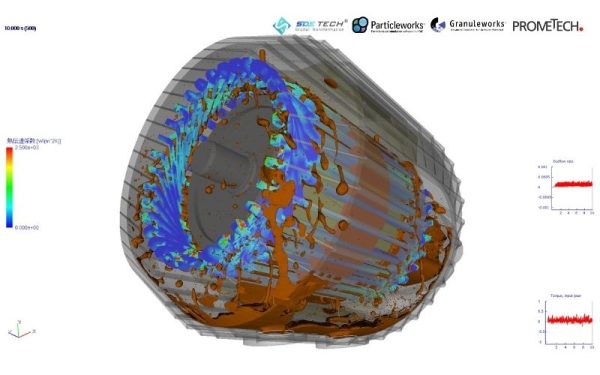
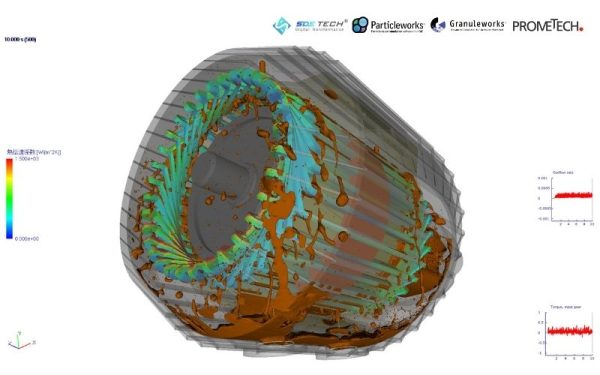
The simulation results enable clear visualization of high-speed oil jets directly impacting the stator windings. More importantly, the software allows extraction of Heat Transfer Coefficient (HTC) data across the entire motor surface. This is critical information that helps engineers precisely understand the local cooling effectiveness of the electric motor at each specific location.
Despite the complexity of simulating millions of particles, the entire workflow required only approximately 6 days of computation on a single GPU, thanks to Particleworks’ outstanding hardware acceleration capabilities.
3. Validating accuracy through a coupled CFD–FEA workflow
A simulation only delivers real value when it accurately reflects physical reality. To predict the actual operating temperature of the motor, the HTC data generated by Particleworks was coupled with finite element heat transfer analysis (FEA) using a dedicated solver.
The oil flow data was mapped onto the FE model, while fully accounting for the insulation properties of the stator windings. The final results were highly compelling: when compared with experimental measurements at six different locations on the windings, the temperature deviation between simulation and test data was within ±2.8°C.
This strong correlation confirms that the CFD–FEA coupled workflow is a reliable virtual engineering tool. It enables manufacturers to design and fine-tune thermally optimized motor cooling systems from the earliest stages of the development cycle, significantly reducing the cost and time associated with physical prototyping and iterative testing.
4. Frequently Asked Questions
Below are some of the most common questions from engineers and engineering managers when exploring this electric motor cooling simulation solution:
4.1 Why use particle-based CFD (MPS) instead of conventional CFD for electric motors?
The MPS (Moving Particle Semi-implicit) method is mesh-free, significantly reducing model setup time. More importantly, it excels at handling free-surface flow problems such as oil splashing, jet injection in gearboxes, or rotating motors—scenarios where traditional mesh-based CFD often suffers from mesh distortion and large numerical errors.
4.2 Can this solution be applied to systems other than electric vehicle motors?
Yes. This technology is highly effective for any lubrication and cooling system, including transmissions, drive axles, internal combustion engines, and a wide range of industrial machinery that require optimization of high-power motor cooling performance.
4.3 How accurate is the simulation compared to real-world measurements?
As demonstrated in the case study referenced in this article, the temperature deviation was only ±2.8°C. However, overall accuracy depends on the quality of input data—such as material properties and geometric fidelity—as well as the engineer’s experience in setting up the simulation.
Particleworks not only optimizes electric motor thermal management but also sets a new benchmark for next-generation electric vehicles. To master advanced simulation technologies and achieve optimal thermal performance for your products, connect with SDE Tech—a leading industrial solution partner in Vietnam.
*Content adapted from particleworks-europe.com
- Email: sales@sde.vn
- Hotline/Zalo: 085 256 2615 – 0909 107 719