Tiếng Việt
 日本語
日本語 한국어
한국어
In the plastics industry, maintaining consistent injection molding product quality is a significant engineering challenge. Product quality is not determined by a single factor but by the complex interaction between material properties and mold design. In addition, machine operating parameters and environmental conditions play a decisive role in ensuring dimensional accuracy. Tight control of these variables enables manufacturers to minimize defects and achieve stable, high-quality production outcomes.
1. Importance of Controlling Injection Molding Product Quality
Failure to maintain consistent injection molding product quality can lead to direct consequences such as increased material costs due to scrap, extended delivery times, and, most importantly, damage to brand reputation with customers and partners.
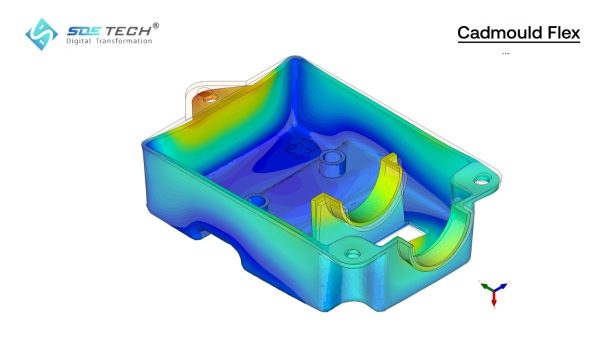
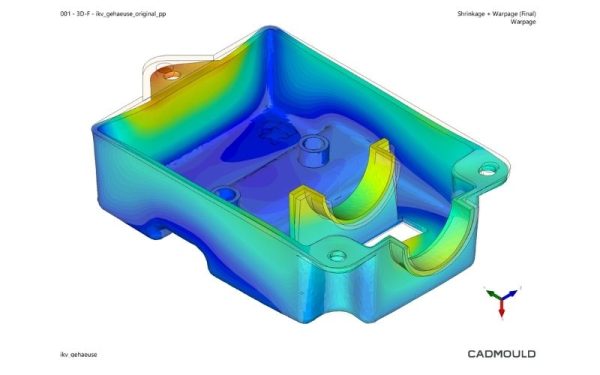
A high-quality plastic part must meet key criteria, including dimensional accuracy, mechanical strength, and surface finish. To achieve this, manufacturers need to implement strict process control methods—from material preparation to part ejection from the mold. Understanding the factors that influence quality enables engineers to proactively adjust parameters and prevent common defects such as warpage, sink marks, and weld lines.
2. Factors Affecting the Injection Molding Process
2.1 Plastic Material Factors and Their Impact on Final Products
Material is the most critical input, directly determining the physical and chemical properties of the final product. The diversity of plastic materials (PP, ABS, PC, PA, etc.) introduces different challenges during processing.
To ensure injection molding product quality, material purity and moisture content must be strictly controlled. Engineering plastics often have high hygroscopicity; if not properly dried before feeding, trapped moisture in the molten material can cause surface defects such as silver streaks or internal bubbles. Additionally, each material has a different shrinkage rate, requiring precise compensation in design to avoid dimensional inaccuracies in the final part.
See more: What is Plastic Injection Molding? The Manufacturing Process of Plastic Parts
2.2 Mold Design – The Foundation of Accuracy
If the injection machine is the driving force, the mold is the “core” that defines the product geometry. Poor mold design is one of the leading causes of injection molding defects that cannot be fully corrected by machine adjustments.
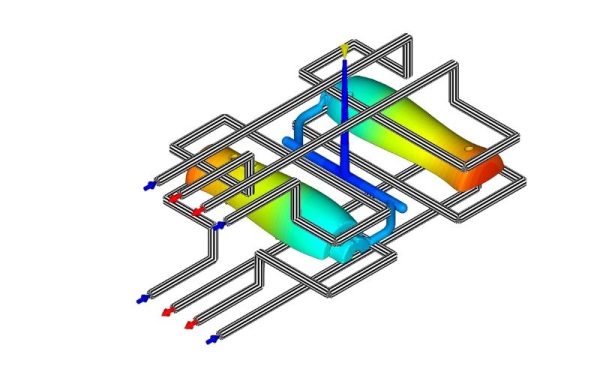
Key mold design factors include the gate system, runner system, and venting system. Improper gate location can lead to uneven flow, causing internal stress and warpage. The cooling system is especially critical, as it directly affects cycle time and dimensional stability. Non-uniform cooling can result in uneven shrinkage, leading to severe deformation after part ejection.
2.3 Machine Parameters and Process Stability
With proper material and mold design, machine parameter setup becomes the key to achieving consistent injection molding product quality. The process is governed by the interaction of temperature, pressure, and time.
- Melt temperature: Too low leads to incomplete filling (short shots); too high may cause material degradation and discoloration
- Injection pressure and holding pressure: Injection pressure fills the cavity, while holding pressure compensates for shrinkage. Insufficient holding pressure often results in sink marks
- Injection speed: Too fast can cause burning due to friction; too slow may create visible weld lines, reducing aesthetic quality
Even small variations in these parameters can alter flow behavior and directly affect consistency across production batches.
2.4 Impact of Environment and Human Factors
Environmental conditions are often overlooked but significantly influence injection molding product quality. Ambient temperature and humidity can affect mold cooling rates and material dryness.
In addition, the expertise of operators and technicians plays a crucial role in managing the entire process. Early detection of machine abnormalities or changes in material behavior requires deep experience in injection molding operations. A well-structured quality control (QC) system with precise measurement standards is essential to maintain consistent and high product quality.
3. Simulation Solutions to Improve Injection Molding Product Quality
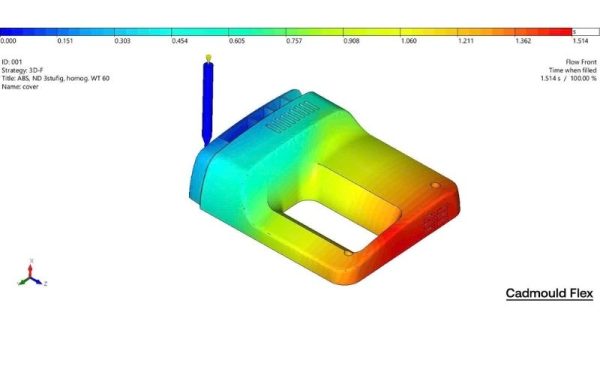
To effectively address complex plastic defects, relying on trial-and-error methods on actual machines is both costly and time-consuming. Today, leading manufacturers adopt injection molding simulation solutions before physical production.
At SDE TECH, we provide solutions such as Cadmould Flex, enabling engineers to visualize the entire mold filling process and accurately predict potential defects such as surface imperfections, air traps, and warpage. Through simulation, companies can optimize gate locations and cooling channel systems during the virtual design phase. Implementing this technology is a strategic approach to achieving target injection molding product quality from the first trial, significantly reducing tooling costs and development time.
4. Frequently Asked Questions About Injection Molding Product Quality (FAQ)
4.1 How can sink marks be fixed on plastic parts?
This defect usually appears in areas with thick wall sections. To improve injection molding product quality in this case, you should increase holding pressure and holding time, and also review the cooling system to ensure that thicker regions are properly cooled.
4.2 Why do plastic parts warp after ejection from the mold?
Warpage is mainly caused by non-uniform shrinkage. This may result from temperature differences between the two mold halves or inconsistent wall thickness design. Using injection molding simulation software helps identify the root cause and provides optimized design corrections.
4.3 How important is the mold venting system?
It is extremely important. If air is not properly vented during filling, trapped air increases pressure and causes burn marks at the end of flow or creates air pockets inside the part. This significantly reduces both aesthetics and mechanical strength.
Ensuring injection molding product quality is a continuous process that requires deep technical understanding and close coordination between material selection, mold design, product design, and machine parameters. In today’s highly competitive environment, applying advanced technologies and engineering software is the fastest way for manufacturers to achieve superior quality and optimize production costs.
At SDE TECH, we not only provide advanced software solutions but also support enterprises with technical consulting and production optimization. Contact our expert team today to enhance your manufacturing performance.
- Email: sales@sde.vn
- Hotline/Zalo: 085 256 2615 – 0909 107 719