Tiếng Việt
 日本語
日本語 한국어
한국어
In modern engineering, predicting how fluids (liquids and gases) interact with product surfaces is a critical factor in ensuring performance and durability. In the past, engineers had to rely on building physical prototypes and conducting expensive tests in wind tunnels or specialized testing facilities. Today, flow simulation technology—commonly known as Computational Fluid Dynamics (CFD)—has completely transformed this process.
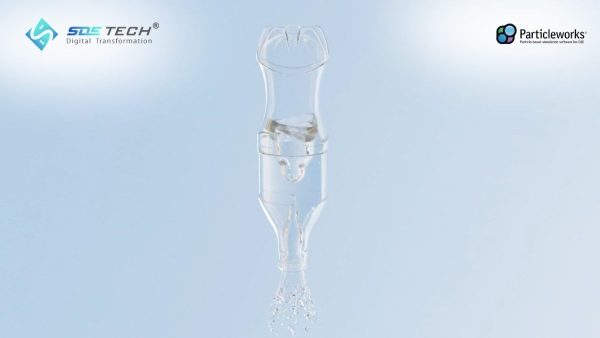
1. What is the In-depth Concept of Flow Simulation?
To fully understand its practical value, it is essential to define the technical nature of flow simulation. This field is a branch of Fluid Mechanics that uses numerical methods and algorithms to solve and analyze problems related to fluid flow. The process is based on solving the Navier–Stokes equations—a set of complex mathematical equations describing the conservation of mass, momentum, and energy in fluids.
Within a simulation environment, the space around or inside a product is divided into millions of small cells (mesh) or discrete data elements. At each point, the software calculates key parameters such as velocity, pressure, temperature, and density. The result is a highly detailed visual map that allows engineers to “see” how fluids behave—helping identify vortices, pressure drop zones, or areas with poor heat dissipation. Mastering Computational Fluid Dynamics (CFD) is therefore the key to fully controlling the physical variables that impact product performance.
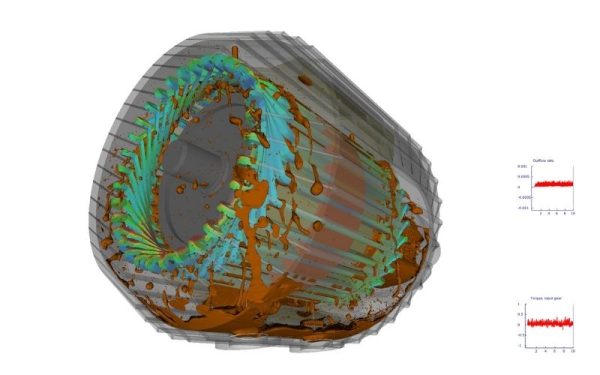
2. The Role of Flow Simulation in Design Optimization
The ultimate goal of any engineering process is to achieve the highest performance at the lowest possible cost. Computational Fluid Dynamics (CFD) serves as a guiding tool for design optimization through the following key aspects:
2.1 Aerodynamic and Hydrodynamic Optimization
For moving products such as cars, aircraft, and ships, air or water resistance directly impacts energy consumption. Through flow simulation, engineers can refine surface geometries to minimize the drag coefficient, resulting in smoother operation and significant fuel savings. Conversely, for systems requiring lift or downforce, simulation helps determine the optimal wing shape and angle to achieve desired performance characteristics.
2.2 Thermal Management and Efficient Cooling
In industries such as electronics and electric vehicles (EVs), thermal control is mission-critical. Flow simulation enables analysis of airflow within enclosures or coolant flow around battery systems. Engineers can virtually test different fan placements, heat sink designs, and flow rates. Optimizing thermal systems helps prevent overheating, extend component lifespan, and ensure user safety.
2.3 Improving Mixing Efficiency and Chemical Reactions
In food processing, pharmaceuticals, and chemical industries, uniform mixing is essential. Flow simulation allows engineers to analyze concentration distribution and flow velocity within mixing tanks. By optimizing impeller design and rotational speed, manufacturers can achieve higher uniformity in shorter timeframes—directly improving productivity and product quality.
3. Two Main Approaches in Fluid Simulation
Today, depending on the nature of the engineering problem, companies typically choose between two primary approaches to perform Computational Fluid Dynamics (CFD) analysis. Each method offers unique advantages in supporting design optimization.
3.1 Mesh-based CFD Method
This is the most widely used approach, with solutions such as Simcenter STAR-CCM+ from Siemens. In this method, the entire computational domain is divided into a grid (mesh). Mesh-based CFD is highly effective for simulating steady flows, compressible flows, and complex heat transfer problems. However, generating high-quality meshes for geometrically complex models can be time-consuming and requires significant engineering effort.
3.2 Meshless / Particle-based CFD Method
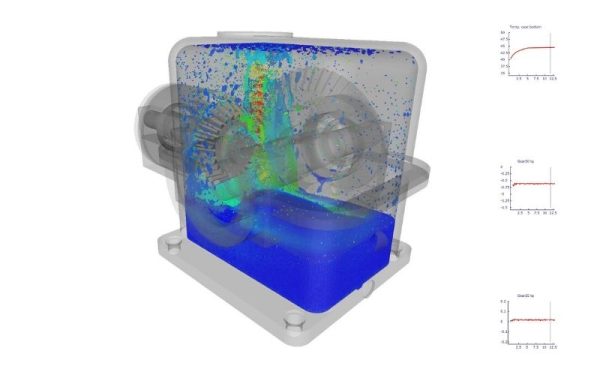
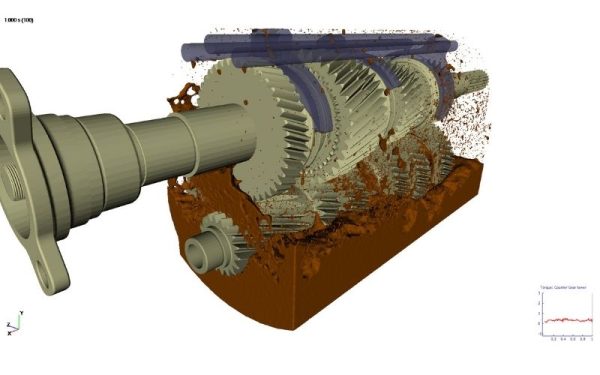
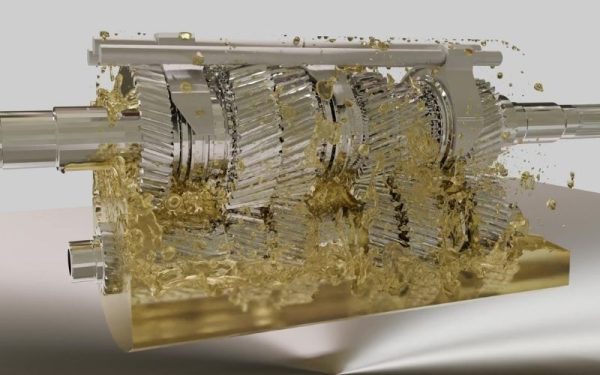
This is an advanced approach led by solutions like Particleworks. Instead of using a mesh, the software applies the Moving Particle Simulation (MPS) technique, representing fluids as millions of discrete particles. This method is particularly effective for problems involving large free-surface deformation, such as water splashing, oil churning in gearboxes, or food washing processes. By eliminating the complex meshing stage, particle-based CFD allows engineers to focus directly on physics-driven insights and accelerate the design optimization process.
4. Workflow for Implementing Flow Simulation in Design Optimization
To achieve practical results, applying Computational Fluid Dynamics (CFD) must follow a rigorous engineering workflow to ensure data accuracy and transparency:
- Pre-processing (Geometry setup): Import the product’s CAD model and define the surrounding fluid domain. Unnecessary geometric details that do not affect fluid behavior are removed to optimize computational efficiency.
- Boundary condition definition: Set input parameters such as inlet velocity, outlet pressure, fluid properties (viscosity, density, thermal conductivity), and internal heat sources.
- Solving: The solver performs iterative calculations to reach a converged solution based on governing equations such as the Navier–Stokes equations.
- Post-processing (Result analysis): Use visualization tools such as streamlines, velocity vectors, and pressure or temperature contours to evaluate performance.
- Iteration and optimization: Based on identified issues, modify the design and rerun simulations until the desired design optimization objectives are achieved.
5. Frequently Asked Questions About Flow Simulation (FAQ)
5.1 Are flow simulation results completely accurate compared to real-world results?
The accuracy of Computational Fluid Dynamics depends on mesh quality (or particle resolution), the accuracy of boundary conditions, and the selected mathematical models. With leading software such as Simcenter STAR-CCM+ and Particleworks, when properly set up by experienced engineers, simulation results can typically achieve over 95% correlation with experimental data.
5.2 Does flow simulation require high-performance computing resources?
Yes. CFD simulations demand significant parallel processing capability. Mesh-based methods require large RAM capacity and multi-core CPUs, while particle-based approaches like Particleworks benefit greatly from high-end GPUs, which can accelerate computation by several times.
5.3 Should you choose mesh-based or particle-based methods for design optimization?
The choice depends on the application. For airflow around vehicles or thermal analysis in electronic devices, mesh-based CFD is typically preferred. For problems involving oil splashing, flooding, or free-surface fluid mixing, particle-based methods offer superior performance and flexibility.
Flow simulation using Computational Fluid Dynamics has become an indispensable tool in modern engineering workflows. Its ability to accurately predict and analyze fluid behavior in a virtual environment enables businesses to make confident, data-driven design optimization decisions.
At SDE TECH, we are committed to supporting your journey in solving complex engineering challenges and unlocking the full potential of simulation-driven design.
- Email: sales@sde.vn
- Hotline/Zalo: 085 256 2615 – 0909 107 719