Tiếng Việt
 日本語
日本語 한국어
한국어
VISUALIZATION WORKFLOW FOR THE MARITIME INDUSTRY WITH NX DESIGN – PART 1
Introduction
Do you know how crucial an efficient visualization workflow is for the successful operation of companies? We hope you have explored our previous NX Render blogs on visualization to understand this integrated process better. If not, you can learn about this workflow in consumer products here, along with a series of heavy-duty equipment. We will bring you a set of new demo videos, focusing on the maritime sector.
The video describes an efficient visualization pipeline, which is fundamental across all fields for any CAD dataset when visualizing a digital twin. We will join Gavin McCambridge, a visualization expert, who will discuss in detail how a large and sophisticated model like this is created using NX Render. This first part will focus on model setup, Visual Bill of Materials (VBOM), and Realize Shape.
Model Received
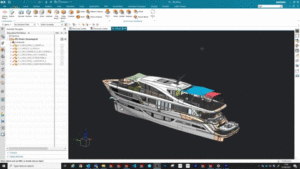
The model we are focusing on here is clearly very large and complex.
“Once we received and started working with the model, the first thing I do is review it. I open it in NX and focus on examining its structure. How are the assembly details set up? Are they named correctly? Are they using a numbering system? I can’t understand everything immediately, but the model has been completed.”
This stage may vary depending on your role in the company. For Gavin, he always reviews various datasets, whereas you may be working on a specific model and get familiar with it quickly. The key point for step one is truly understanding the model inside and out. This process makes any subsequent modifications in the workflow much easier, as the model will be set up in a way that allows smooth navigation.
The Importance of Research
Next is the research phase. We have all seen yachts, whether at Monaco marinas or on Google searches. Style is class, and the yacht’s real-world setup is critical, and this is where research begins.
“The first thing I want to do is understand the brand I am working with. I research the company and its profile. What is their website like? I brainstorm the visual style they use to present their products.”
We have discussed this in previous blogs. It may seem like a basic step, but it is equally essential. If you do not understand your model and industry, you will not achieve realism to the same standard. NX Render allows you to use features that help present the model and leverage prior research.
Setting Up the Visual Bill of Materials (VBOM)
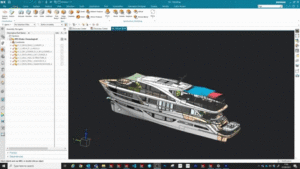
Now we are at the stage where we can set up the Visual Bill of Materials, or VBOM. This is a clever trick to focus on specific design areas you want. It is very helpful in the workflow at this stage if VBOM and EBOM (Engineering BOM) are separated.
TOP TIP:
“VBOM allows us to work and do everything we need within a separate area. That is the main reason we do it, and it is a fairly easy setup. Essentially, we have a clear set on top to preserve different data streams. We can have EBOM as is without touching it, and below we have VBOM.”
Managing Different Data Types in NX Render
Focusing on a large, impressive model can be overwhelming. It seems hard to keep your engineering data separate from visualization data. Here is what Gavin thinks about managing different data types efficiently.
“What we discussed about VBOM earlier helps keep my visualization data separate from engineering data. This also means engineering data can be processed independently. It can be updated, and these changes can propagate to the dataset I’m using with VBOM. So the new geometry I add for visualization purposes never affects EBOM.”
Supplementary Geometry and Realize Shape
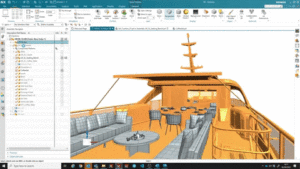
Looking at the yacht, arguably one of the most exciting parts of the model is the detail and structure that look realistic. The interior fits around the lounge area, and a little natural clutter creates authenticity, to which we can add supplementary geometry.
“A fundamental aspect of this type of model is the yacht’s structure, in addition to all the furnishings we want to add to make the yacht look livelier. We used Realize Shape.”
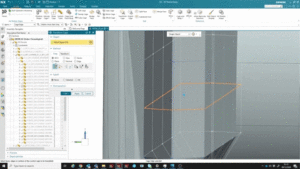
Realize Shape is a soft body modeling tool in Siemens NX that uses polygonal models to improve a smoother appearance when applying new shapes. Simply put, it allows users to add stock shapes into the scene, which can then be manipulated, stretched, rotated, pulled, and ultimately attached to other geometry in the scene.
For example, outside the yacht, we see cutlery and plates on the table. Gavin created these using Realize Shape to add depth to the scene and ultimately bring the model to life.
Source: Siemens
SDE TECHNOLOGY CO., LTD (SDE TECH) was founded in 2014. By 2018, we proudly became a Smart Expert Partner – the leading partner of Siemens Digital Industries Software in Southeast Asia – Pacific for Siemens NX (Unigraphics NX), Simcenter, Solid Edge, Tecnomatix, and Teamcenter solutions.
 For inquiries, contact SDE TECH as follows: