Tiếng Việt
 日本語
日本語 한국어
한국어
In gearbox, transmission, and drivetrain design, one of the most challenging problems lies not in the mechanical geometry, but in how the lubrication oil behaves inside the system. The oil must reach the right locations at the right time, while minimizing churning losses, controlling temperature, and preventing issues such as aeration or air ingestion at the pump inlet. Particleworks is specifically developed to simulate lubrication oil behavior using the MPS (Moving Particle Simulation) method, enabling engineers to visualize and evaluate oil dynamics within gearboxes, transmissions, powertrains, and complex bearing systems.
1. What is Particleworks?
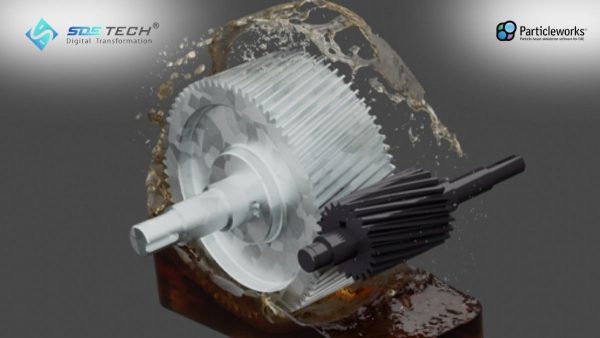
Particleworks is a particle-based CAE simulation software that uses the Moving Particle Simulation (MPS) method to analyze free-surface flows and incompressible fluids. MPS is particularly well-suited for problems involving large fluid motion, complex geometries, and dynamic free surfaces.
Particleworks enables engineers to simulate and evaluate lubrication oil behavior as well as torque characteristics within gearboxes. It also provides a range of application cases, including transmission systems, eAxles, oil distribution, bubble generation, and other lubrication-related analyses.
2. Why Is Lubrication Oil and Bearing Simulation Important in Gearboxes?
2.1 Lubrication Directly Impacts System Performance
In gearboxes and transmissions, lubrication oil does more than reduce friction—it also plays a critical role in cooling, wear reduction, and maintaining the durability of rotating components. If oil distribution is inadequate, the system may experience localized lubrication failure, increased temperature, accelerated wear, and reduced operational reliability.
2.2 Churning Losses Reduce Drivetrain Efficiency
As gears rotate in an oil environment, part of the energy is dissipated in stirring and dragging the fluid, resulting in churning losses. A gearbox lubrication case study from Particleworks Europe highlights that reducing churning losses is one of the key challenges in the automotive industry—especially when developing more efficient passive lubrication systems.
2.3 Bearing Lubrication Requires a Balance Between Performance and Losses
In bearing systems, lubrication reduces friction and wear. However, excessive agitation of oil or grease can increase rotational losses and negatively impact overall efficiency. Simulation can evaluate lubrication behavior in a differential gearbox, including the load torque generated by lubricant viscosity on drivetrain components.
3. What Problems Can Particleworks Solve in Gearboxes and Bearings?
3.1 Oil Sloshing and Distribution
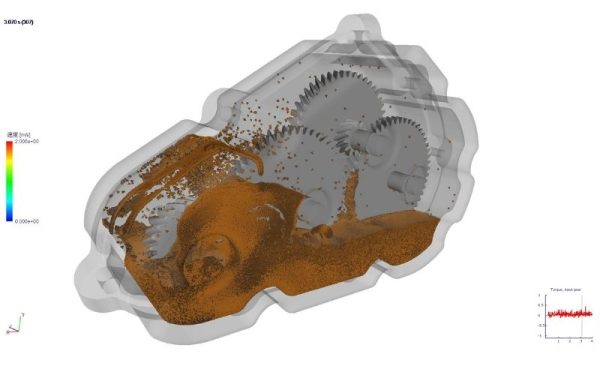
A key challenge in gearboxes is oil sloshing—the movement, accumulation, and redistribution of oil due to rotation, orientation changes, or acceleration. Particleworks simulates oil motion induced by multiple rotating gears and allows measurement of oil volume in critical regions, as well as torque generated by fluid forces on shafts.
3.2 Flow Analysis and Baffle Design
To control oil flow direction, engineers often design baffles or internal guiding structures within the gearbox housing. Particleworks enables visualization of oil distribution within transmissions, supporting the design of effective oil management systems and optimized lubrication delivery.
3.3 Oil Intake Reliability and Air Ingestion Prevention
At pump inlets or suction zones, air ingestion can cause cavitation and reduce system stability. Particleworks can simulate bubble formation and transport caused by gear agitation, helping engineers assess the impact of aeration on lubrication performance.
3.4 Heat Transfer Coefficient and Thermal Behavior
Beyond flow simulation, Particleworks is also applied in motor cooling and thermal co-simulation scenarios. For gearboxes, thermal behavior is critical, as oil temperature directly affects viscosity, lubrication effectiveness, and energy losses.
3.5 Wetted Areas and Lubrication Coverage
A practical design question is: Which areas are effectively lubricated, and which are not? Particleworks provides visualization of wetted areas in planetary gear systems and transmissions, enabling engineers to evaluate whether oil reaches critical regions under complex operating conditions.
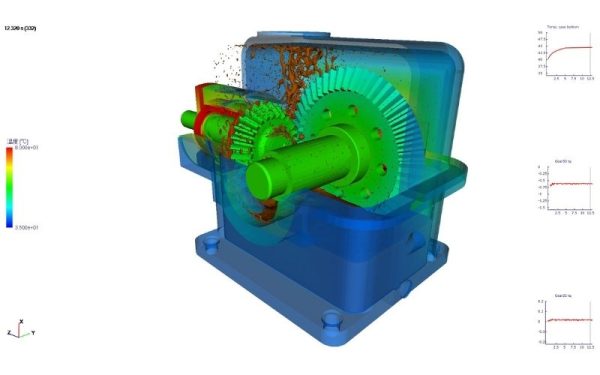
4. How Does Particleworks Work in Gearbox Applications?
4.1 Particle-Based Simulation for Free-Surface Flow
The MPS method is specifically designed for incompressible fluids and free-surface flows. This makes it highly effective for capturing oil splashing, separation, merging, and dynamic surface behavior—areas where traditional mesh-based CFD often struggles.
4.2 Handling Complex Geometry and Large-Scale Models
Particleworks has demonstrated the capability to simulate large transmission systems with tens of millions of particles, highlighting its ability to handle complex gearbox geometries at scale. Case studies also show that lubrication simulations for smaller systems, such as bevel gear transmissions, can be performed efficiently and accurately.
4.3 Coupling with Other Simulation Models
Particleworks supports co-simulation approaches such as MPS + FVM, MPS + DEM, and MPS + SDK. This capability is particularly valuable for modern drivetrain systems, where fluid behavior must be analyzed alongside thermal, structural, or dynamic interactions.
5. Practical Benefits of Using Particleworks for Gearboxes and Bearings
Support for modern powertrains: Well-suited for electric vehicle systems, where thermal and lubrication requirements are increasingly demanding
Reduced testing cycles: Simulate lubrication behavior digitally, reducing reliance on physical prototypes—especially valuable in early design stages
Multi-scenario evaluation: Analyze various drivetrain systems, including transmissions, planetary gears, and bevel gears under different operating conditions
Optimization of lubrication vs. losses: Understand the relationship between oil distribution, torque, and aeration to balance lubrication effectiveness and churning losses
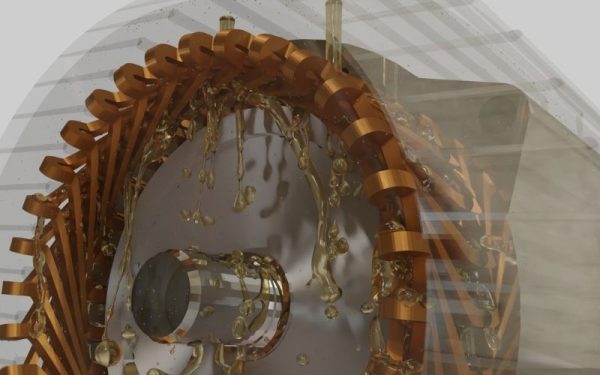
6. Frequently Asked Questions About Particleworks for Gearboxes and Bearings
6.1 Can Particleworks simulate bearing lubrication?
Yes. It can simulate lubrication behavior in differential gearboxes and evaluate load torque caused by lubricant viscosity.
6.2 Is Particleworks suitable for electric drivetrains?
Yes. It includes case studies for eAxle and electric powertrain systems, demonstrating its applicability to electrified drivetrains.
6.3 Does Particleworks support aeration and bubble simulation?
Yes. It includes dedicated case studies on bubble generation caused by gear oil stirring, analyzing the formation and movement of air bubbles in lubrication oil.
Particleworks is a compelling solution for lubrication simulation in gearbox and bearing applications because it directly addresses the most critical drivetrain challenges: whether the oil reaches the right locations, whether excessive churning losses are generated, whether aeration or lubrication deficiencies occur, and how operating temperature varies under load. If your organization is looking to optimize performance, reduce fluid-induced losses, and improve drivetrain reliability, Particleworks is a highly valuable addition to the design process. Contact SDE Tech for consultation:
- Website: sde.vn
- Email: sales@sde.vn
- Hotline/Zalo: 085 256 2615 – 0909 107 719