Tiếng Việt
 日本語
日本語 한국어
한국어
ACCELERATING INDUSTRIAL ADDITIVE MANUFACTURING PRODUCTION
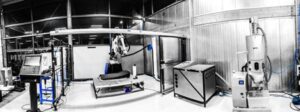
Additive manufacturing (AM) and 3D printing capture the imagination of engineers regardless of age, experience, or discipline. While this is generally a desirable quality for any new technology, it can be a double-edged sword that leads to unrealistic expectations of its capabilities. AM is sometimes viewed as a replacement for all traditional manufacturing industries. It introduces creative and increasingly essential development techniques.
To gain deeper insight into how industrial additive manufacturing is being applied with growing popularity, Ashley Eckhoff—one of Siemens’ experts in 3D printing—published an excellent article on PhotonicsViews.
The drivers accelerating adoption of this industry include greater performance of produced components, a gradual learning approach, and comprehensive simulation environments for knowledge acquisition. Benefits are realized across design, planning, and production. Through continued investment, increasingly automated workflows enable personnel to contribute more effectively to component performance.
Performance of Additively Manufactured Components
When working with 3D printing, it becomes possible to manufacture components optimized for topology without the simplifications typically required by traditional techniques. Engineers can now extract every last ounce of performance with sufficient understanding of the underlying processes. This can be achieved through lightweight parts by removing unnecessary regions of the original geometry or by filling components with lattice structures instead of solid material.
Flow-based optimization is another area seeing increasing adoption, delivering more efficient flow characteristics by shaping components according to system physics. This approach is also used for lightweighting, most commonly in electric vehicles (EVs), where every ounce translates directly into battery range and reliability.
However, in most cases, the performance of a given component must be balanced with other attributes such as manufacturability, total cost, and durability, making system-level understanding a critical factor for development.
Small-Scale Manufacturing Projects
From the perspective of AM production and planning, it is essential to understand AM process knowledge. Although AM tools are becoming increasingly intuitive—allowing complex designs to be applied without deep expertise—this can easily result in excessive part distortion and may even damage equipment.
To build an understanding of AM production processes, some companies choose to experiment by manufacturing custom fixtures and production aids before moving on to direct printing. This is an excellent learning approach for two main reasons. First, these auxiliary parts are typically far easier to model and 3D print than full-scale components.
There are models that must be reworked due to errors, which can be mitigated through continued use of additive manufacturing. Second, this is a secondary process, and routine shop-floor operations can largely continue as normal, allowing companies to reduce upfront investment in the technology while still accumulating experience.
Early Simulation
For all cases where initial domain knowledge is inaccurate, impractical, or too time-consuming, simulation is an excellent tool to fill the gaps in AM development.
In AM, this can occur throughout the development cycle. Topology optimization to improve performance relies on simulating final-stage components. Some designs can be created manually, but expanding computational power enables more iterations alongside traditional engineering methods. This also applies to production planning. Part of the experience gained through smaller projects is understanding the impact of build orientation within the printer.
Minor changes can affect component strength or cause overheating that leads to distortion.
Simulation removes this variability from the equation by testing different options before the printer is activated. For any process change—from printing material to the machine in use or even the printer firmware version—significant relearning is required. All of this makes simulation a critical part of the AM development process that should begin as early as possible.
Accelerating Industrial Additive Manufacturing
Additive manufacturing is a highly promising and revolutionary technology for the future of manufacturing, but harnessing its capabilities requires foresight. Sometimes this comes in the form of design planning or process simulation.
Regardless of how you begin implementing AM, it is essential to understand why you are using it, what benefits it provides over other methods, and how to maximize its potential by leveraging the best tools available. For more information on how Siemens is accelerating the adoption of additive manufacturing at an industrial scale, please refer to the article by Ashley Eckhoff in PhotonicsViews.
Source: Siemens
SDE Digital Technology Co., Ltd. (SDE TECH) was established in 2014. In 2018, we were honored to become a Smart Expert Partner—the leading partner of Siemens Digital Industries Software in the Southeast Asia–Pacific region—for Siemens NX (Unigraphics NX), Simcenter, Solid Edge, Tecnomatix, and Teamcenter management solutions.
 Enterprises and customers wishing to contact SDE TECH may use the following information: