Tiếng Việt
 日本語
日本語 한국어
한국어
ANC TECHNOLOGY – ACTIVE NOISE CANCELLATION
ANC technology enhances cabin comfort. In this article, we share insights into reducing drivetrain and road noise perception while highlighting the benefits of switching to software-based acoustics.
Cabin noise has traditionally been addressed by thickening window glass or adding damping materials between the interior and exterior of the cabin. With lightweight and fuel-efficient strategies driving vehicle development, alternative technologies are needed to ensure noise does not enter the cabin.
There are several sources of vehicle noise. The most prominent sources are road noise, wind noise, drivetrain noise, and noise from cooling fans, HVAC, or other components.
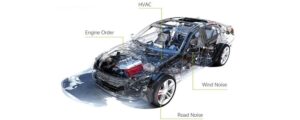
Vehicle noise sources affecting cabin comfort (Photo: CarBikeTech)
For internal combustion engines, manufacturers have traditionally optimized engine placement and body structure to reduce noise. They also added artificial sounds to mask, modify, or enhance engine noise. However, the drivetrain no longer dominates the sound profile of next-generation vehicles.
External noises, such as road and wind noise, affect driver comfort in electric vehicles. Unlike adding sound to the vehicle, customers may prefer quiet in certain situations.
Today, manufacturers have found a solution with in-vehicle active noise cancellation. ANC technology improves cabin comfort and reduces material costs while keeping vehicle weight to a minimum.
Hyundai’s mission for a smoother ride
Nearly two years ago, Hyundai launched the Road-Noise Active Noise Control (RANC) system to deliver a smoother ride. See article: Hyundai’s World’s First Road-Noise Active Noise Control, RANC. The manufacturer predicted that cabin quietness and NVH comfort would be key purchase decision factors.
”ANC technology with road noise elevates existing NVH performance to a new level.”
–Gangdeok Lee, Research Member of the NVH Research Laboratory, Hyundai Motor Group–
What is ANC and how does it work?
ANC technology detects unwanted noise and cancels it using signals transmitted through the vehicle’s audio system. It enhances driving experience while significantly reducing vehicle weight.
Siemens’ broadband ANC technology is designed to tackle engine and road noise. It maximizes active noise cancellation benefits and enables software-based acoustics.
Road noise ANC works via actuators such as speakers that generate an anti-noise wave or inverse wave to the original noise. The anti-noise wave has the same amplitude and frequency as the noise source but is inverted (180° phase shift). When combined in the cabin, the original and anti-noise waves cancel each other, resulting in a quieter cabin.
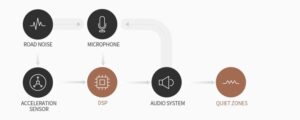
How ANC technology works for road noise (Photo: Hyundai Motor Group)
How it’s achieved
Coordination among components is essential to create the anti-noise spectrum via automotive electronics:
- Microphones and accelerometers: capture and analyze the waveform of the noise to be canceled. The recorded signals are then processed by a digital signal processor (DSP).
- Digital Signal Processor (DSP): analyzes noise captured by microphones and accelerometers. It outputs commands from the ANC algorithm running on the DSP.
- ANC algorithm: generates anti-noise signals. An effective algorithm must be compact and fast for optimal results.
- Speakers: emit anti-noise signals to cancel unwanted sounds from noise sources.
The magic behind ANC
On the surface, it looks simple. In reality, extensive research is required to determine optimal locations for microphones, accelerometers, and speakers to achieve desired results. Siemens collaborates with OEMs to identify the best sensor placement, using proprietary software tools and experience from previous production systems.
ANC footprint on the processor
Over the years, Siemens has upgraded the ANC algorithm. It occupies a small memory and processing footprint while delivering effective noise cancellation. The broadband algorithm removes both low-frequency (engine) and high-frequency (road) noise. Implemented in vehicles, it ensures a comfortable cabin experience for all occupants.
What does the future hold?
Commercial adoption of ANC has accelerated due to factors such as powerful and affordable processors and sensors, software algorithms, and modern tuning techniques. OEMs strive to add new features while maintaining low vehicle weight. Active methods play a key role in reducing NVH and enhancing cabin experience.
As autonomous vehicles become more common, future cars will serve as spaces for meetings, relaxation, and music enjoyment. The quiet provided by ANC will be essential for passenger comfort today and in the future.
Vehicle sound – a reflection of brand personality
Sound engineering enhances every noise source by transmitting sound into the vehicle via the infotainment system. In this article, we focus on ANC to eliminate unwanted interference.
Source: Siemens
SDE Digital Technology Co., Ltd. (SDE TECH) was established in 2014. By 2018, we became a Smart Expert Partner – a leading partner of Siemens Digital Industries Software in the Southeast Asia – Pacific region for Siemens NX (Unigraphics NX), Simcenter, Solid Edge, Tecnomatix, and Teamcenter management solutions.
 Businesses and customers may contact SDE TECH at: