Tiếng Việt
 日本語
日本語 한국어
한국어
Additive Manufacturing in NX
In an effort to expand the capabilities of additively manufactured components, NX™ software has introduced new tools for additive manufacturing (AM) processes along with a robust model-based definition system to support the technology. In a previous blog, I reviewed some of the most notable features from the December 2020 release, but we are revisiting the topic because that was only scratching the surface.
For a comprehensive discussion of the additions to NX, check out the video podcast series by Jennifer Piper and Tod Parrella – Episode 1, Episode 2, Episode 3. Since the first episode includes many powerful tools for AM, you can watch it below.

Whether you are manufacturing consumer products, medical implants, or turbine blades for power generation, AM technology offers clear advantages. While the surface characteristics of AM parts often differ from traditional manufacturing norms, the real value becomes apparent when exploring the internal structures. Below are some of the more exciting features added to NX for AM.
Watertight Solids
One of the greatest benefits of AM is its technological flexibility. Apparel and sports equipment can be perfectly tailored to the user, while medical implants can integrate seamlessly with patient anatomy. These applications rely on individual anatomical scans, meaning precise CAD geometry cannot be used and mesh language files, commonly referred to as STL, must be used instead.
Many engineers, especially those working with AM design daily, dislike STL files because they are outdated, slow, and cumbersome. While STL is unlikely to disappear anytime soon, its issues are not insurmountable—especially with customized software enhancements. Instead of manually remodeling scans within STL files, a secondary mesh file can be wrapped around the object to prevent mesh irregularities.
If wrapping is not possible for a specific application, filling gaps in the model is now much easier. Integrating these tools directly into the modeling software reduces STL preparation time from hours to minutes—or even seconds, depending on the structure.
Lattice Structures
Beneath the surface is where many AM applications truly evolve. Since machines do not remove all material but instead build it layer by layer, internal voids can be created within parts. The true benefit lies not in the voids themselves, but in how they are shaped using lattice structures.
Similar to the bones of birds, parts can be printed with well-bonded material. Unlike solid structures, these internal lattices are purposeful, as there is no need to place material where it serves no function.
While lattice structures are not new to the AM world, recent software advancements have made them significantly easier to implement. Designers and engineers no longer need to program complex geometric functions and manually model them afterward.
Academic solutions are also emerging—Voronoi patterns have been known for years as a means of absorbing energy and sound, and have recently been added as quick, ready-made patterns for AM designs. The future of AM lattice structures will be an exciting story to follow.
Porous Materials
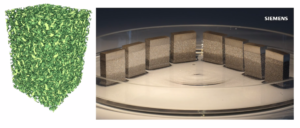
Porous materials are similar to internal lattice structures but are geometrically closer to pumice stone. Fortunately for manufacturers, creating porous materials with AM does not require volcanic levels of energy and is a far more precise process. At FormNext 2020, Dr. Christoph Kiener presented a custom heat transfer device made from a single AM print, using material porosity to drive capillary fluid flow through the device.
Although this capability is not yet fully supported by software solutions, tools are available to ensure accurate fluid flow through dense internal lattice structures. This can be invaluable for internal cooling of components, especially high-temperature turbines—similar designs have already been implemented at Siemens plants with excellent results through Materials Solutions.
Additive manufacturing is still a relatively new technology compared to milling, forging, and other traditional manufacturing methods. Fortunately, the learning curve is being accelerated by comprehensive software solutions covering design, manufacturing, and everything in between. These solutions enable geometries that are not achievable with any other manufacturing technique.
Source: Siemens
SDE Digital Technology Co., Ltd. (SDE TECH) was established in 2014. By 2018, we were honored to become a Smart Expert Partner – a leading partner of Siemens Digital Industries Software in the Southeast Asia – Pacific region for Siemens NX (Unigraphics NX), Simcenter, Solid Edge, Tecnomatix, and Teamcenter management solutions.
 Enterprises and customers who need to contact SDE TECH can reach out via the following information: